
Hou Yifan
Four-time women's world champion, youngest female grandmaster in history and university professor: Hou Yifan's career and choices.
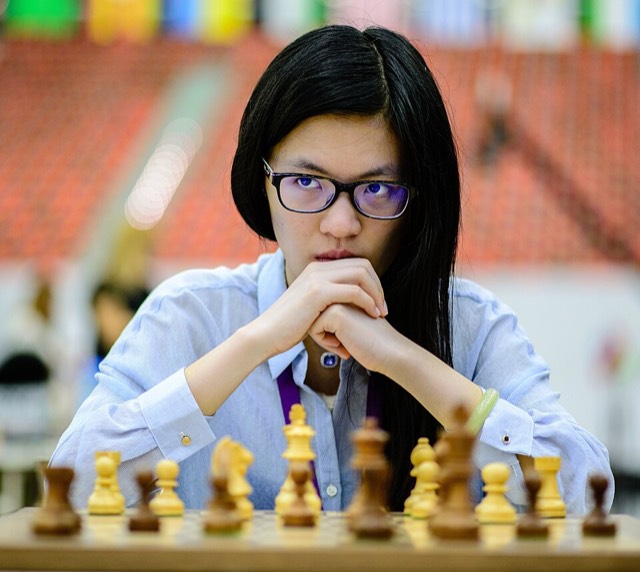
- Born
- February 27, 1994
- Country
- China
- World champion
- 2010-2017 (women's)
- Peak rating
- 2686 (2015)
Hou Yifan is the second strongest female player in history, behind Judit Polgár. She won the women’s world championship four times, then walked away from the cycle. And she became a university professor at twenty-six. The three facts are connected.
From Xinghua to the title
She was born on 27 February 1994 in Xinghua, Jiangsu province. Hou is her family name, Yifan her given name: in Chinese the surname comes first.
The story of her start is charming and documented. Her father, a magistrate, took her to a bookshop after dinner and noticed her staring at glass chess pieces in a display case. He bought her a first set. A few weeks later she was beating her father and her grandmother. At nine, in their first game, she identified almost all the weak moves of Ye Jiangchuan, the national team coach; he concluded she was an exceptional genius. That same year she joined the national team.
In 2008, at fourteen years and six months, she became a grandmaster. She is the youngest woman in history to earn the title, a record still standing in 2026: she broke Polgár’s and Koneru Humpy’s.
She won the women’s world championship four times: in 2010 at Hatay, in 2011 against Koneru Humpy, in 2013 against Anna Ushenina and in 2016 against Mariya Muzychuk. In 2010, aged sixteen, she became the youngest women’s world champion in history.
Her peak rating is 2686, in March 2015. That month she passed Polgár, ending twenty-six years of the Hungarian being the highest-rated woman in the world. She has been the world’s top-ranked woman continuously since September 2015, and still was in early 2026, at around 2600.
What she objected to
This is the heart of her story, and the grievance is technical, not ideological.
Among men, the world champion defends the title in a match. Among women, the title was decided in a sixty-four player knockout tournament. Hou Yifan suffered from that in 2012: she lost her title by being eliminated in the second round, without ever facing the player who took it from her. She won it back in a match the following year.
In 2016 she explained why she was withdrawing from the cycle:
A 64-player knockout event is mostly a lottery: you play two games, and if you lose the first for some reason you have good chances to be eliminated.
She had proposed three solutions to FIDE, including this one: that the winner of the knockout should not be crowned world champion but become the challenger, with the right to face the holder in a ten-game match. That is, exactly the open world championship system. Her remark on how the proposal was received is cutting: they keep promising to consider her requests, to discuss them at Presidential Board meetings, to talk to the other women players, and that had been going on for three or four years.
She declined to defend her title in 2015 and again in 2017, losing it twice by forfeit.
FIDE eventually came round to her view: the match format permanently replaced the knockout from 2020.
Her position, and how it differs from Polgár’s
The two are often mentioned together, and it is a mistake to assume they hold the same position.
Polgár never played the women’s world championship, refusing on principle, and calls for women’s titles to be abolished outright. Hou Yifan played it and won it four times. Her criticism is of the format, not of the category’s existence.
On the causes of the gap at the very top she puts forward several mixed factors: a physical dimension in long games, the fact that men generally work harder at chess growing up, and the observation that most young Chinese women prioritise university and a balanced life. But she also cites an external factor: girls who play are only encouraged to aim at the women’s title, which lowers their motivation.
That is precisely where the two agree. Polgár says the same thing differently: a coach who sees an equally talented seven-year-old boy and girl will tell the boy he can become world champion, and the girl she can become women’s world champion. They agree on the diagnosis and differ on the remedy.
University
In 2012 she enrolled in international relations at Peking University, against her coach’s advice, and took a full-time course. In 2018 she won a Rhodes Scholarship and went to Oxford for a Master of Public Policy. On 10 July 2020, at twenty-six, she became the youngest full professor in the history of Shenzhen University. She has since moved to Peking University.
Her line, in 2018: I want to be the best, but you also have to have a life.
The most honest counterpoint comes from Vladimir Kramnik: if she wants to stay the best female player, he says, she can probably do nothing; if she wants to achieve her potential, she must concentrate fully on chess.
One correction, because the opposite is often written: she has not left chess. She stopped being a full-time professional. She played close to two hundred games in 2025, won the women’s title at the Chinese National Games that September, and finished as most valuable player of the Global Chess League in December.
Gibraltar 2012
This is her greatest performance, and it came while she was a full-time student. At seventeen, rated 2605, she finished equal first with Nigel Short and produced a performance estimated at 2872, the best of the tournament. She beat Polgár, Shirov, Le Quang Liem and Almási, and drew with Adams and Mamedyarov.
Here is the game against Polgár, their first meeting. On move twenty Polgár pushes d4, which weakens her position.
She beats the world number three
Karlsruhe, April 2017, round one of the GRENKE Chess Classic. Facing Fabiano Caruana, rated 2817, she meets the Berlin Defence, reputedly impenetrable. On move twenty-six she opens the h-file.
Caruana resigned on move forty. In the same tournament she drew with Carlsen after coming close to winning.
Her openings
Her repertoire is remarkably narrow, and that is instructive. Across her rated games, roughly ninety per cent of her White games begin 1.e4. With Black against 1.e4, the Sicilian Defence dwarfs everything else, with the French Defence as second choice. Against 1.d4, her most played system is the Ragozin.
A consistent detail: her favourite player as a teenager was Bobby Fischer, which fits that repertoire exactly.
What you can steal from her
A narrow, deep repertoire beats a wide one. She beat a 2817-rated player with a Ruy Lopez, not with a theoretical surprise. Ninety per cent 1.e4, one main defence with Black: specialisation, not variety.
Her career-best performance came while she was a full-time student. That is a useful argument against the fatalism of the amateur who thinks they have no time.
And the pattern of her game against Polgár is reproducible at any level: the opponent plays a weakening move, and after that no concessions follow. The eye for that moment can be trained, and it is what Prologue works on: spotting when a position tips, and knowing what to do with it.
Frequently asked questions
How many times was Hou Yifan world champion?
Four times, in 2010, 2011, 2013 and 2016, across three reigns. In 2010, aged sixteen, she became the youngest women’s world champion in history. She declined to defend the title in 2015 and 2017.
Has Hou Yifan quit chess?
No. She stopped being a full-time professional and withdrew from the world championship cycle, but she still plays a lot: close to two hundred games in 2025, a title at the Chinese National Games that same year, and she remains the world’s top-ranked woman.
Why did Hou Yifan leave the women’s world championship?
Because the title was decided in a sixty-four player knockout, which she described as mostly a lottery. She proposed that FIDE make the knockout winner the challenger, facing the holder in a match, as in the open championship. FIDE eventually agreed: the match format replaced the knockout from 2020.
Is Hou Yifan the best female player ever?
She is second, behind Judit Polgár. Her peak of 2686 remains below Polgár’s 2735, and Polgár is the only woman to have passed 2700 in classical chess and to have entered the world top 10. Hou Yifan did, however, overtake Polgár on the rating list in March 2015 and has been the world’s top-ranked woman since.