
Vladimir Kramnik
World champion from 2000 to 2007, the man who beat Kasparov and revived the Berlin Wall: Kramnik's career, style and openings.
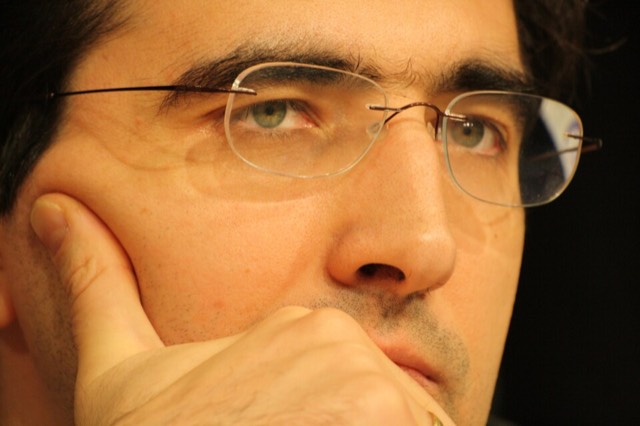
- Born
- June 25, 1975
- Country
- Russia
- World champion
- 2000-2007
- Peak rating
- 2817 (2016)
In 2000, Kramnik beat Garry Kasparov without losing a single game, and he did it with an opening nobody had taken seriously for a century. It is the story of a preparation that wins a world championship by winning almost nothing.
From Tuapse to the title
He was born on 25 June 1975 in Tuapse, on the Black Sea. His mother was a music teacher, his father a painter and sculptor. As a child he studied at the chess school founded by Mikhail Botvinnik, which links him directly to the Soviet positional tradition.
Manila Olympiad, 1992. Karpov is unavailable and it is Kasparov himself who recommends the sixteen-year-old for the Russian team. Controversy follows: he is not even a grandmaster. He finishes with eight wins and a draw from nine games, the best individual score of the tournament. The gold medal is presented to him on his seventeenth birthday. The man who launched him is the one he would dethrone eight years later.
In 2000 in London he beat Kasparov 8½-6½ and ended a fifteen-year reign. In 2004 in Brissago he kept his title against Peter Leko by winning the fourteenth and final game while trailing. In 2006 in Elista he beat Topalov in tiebreaks and reunified a title split for thirteen years: he became the fourteenth undisputed world champion.
He lost the title in 2007, not in a match but at the Mexico City tournament, where Anand finished first and he second. The 2008 rematch in Bonn, where he was now the challenger, ended in a 4½-6½ defeat.
His peak rating of 2817 dates from October 2016 — sixteen years after his title. He retired from classical chess in January 2019, at Wijk aan Zee.
The Berlin Wall
This is the heart of his story, and the best lesson in preparation strategy ever given.
In 2000 Kasparov opens 1.e4. Kramnik replies with the Berlin Defence to the Ruy Lopez: 3…Nf6 instead of the classical 3…a6. A nineteenth-century opening nobody took seriously any more. After 4.O-O Nxe4 5.d4 Nd6 6.Bxc6 dxc6 7.dxe5 Nf5, the queens leave the board on move eight.
Look at what this position does to Kasparov. Black’s king is in the centre and can no longer castle, which looks disastrous. Except that the queens are gone: no mating attack is possible. The defect is purely cosmetic. The greatest attacker in the history of the game is stripped of his weapon on move eight.
The rest follows the same logic. Black has the two bishops in exchange for doubled pawns. Each side has a pawn majority, but Black’s is doubled and therefore very hard to turn into a passed pawn: neither side can create much. Above all, it is a manoeuvring position, not one of forcing variations. And Kasparov’s strength, and all his computer preparation, rested on concrete, sharp positions. The Berlin gave him nothing to calculate.
The result: Kramnik played the Berlin four times with Black and all four games were drawn. It won no games. It made his Black games unlosable. Freed of worry on one side, he only had to win twice with White. Kasparov won no games in the match.
Before 2000 the Berlin was a curiosity. Today Carlsen, Anand and Caruana all play it: it has become a pillar of the elite repertoire.
The game that sealed the match
London, game ten, Kramnik with White in a Nimzo-Indian. On move fifteen he tears open the black king’s shelter with a bishop sacrifice.
Kasparov resigned on move twenty-five. Looking back on the match, he acknowledged overestimating the role of computer analysis and failing to read his opponent, and said Kramnik had come with fresh ideas and contributed a great deal to the development of the game.
His style and openings
Kramnik plays preparation, restraint and technical pressure rather than constant attack. His best games look calm right up to the moment his opponent realises there is no counterplay left.
His preparation method says everything: about an hour understanding the opponent’s style, then an hour choosing the concrete variation. His advice for building a repertoire matches his career — work on solid, well-known lines.
With Black, the Berlin and the Petroff, two openings of solidity. With White, his most creative contribution is the Catalan, which he revived and enriched to the point of making it one of the most played openings in the world.
Two instructive setbacks
In 2006 he lost a match to the program Deep Fritz without winning a single game. In the second, after 34.Nxf8, he played 34…Qe3 and was mated in one. A reigning world champion missing a mate in one is worth knowing about when you are berating yourself over your own blunders.
The other point, heavier, concerns his current situation. Retired from classical chess since 2019, Kramnik has remained a commentator and analyst, and from 2023 made public cheating accusations against several players. On 3 July 2026 the FIDE disciplinary chamber found him responsible for breaches of the ethics code and imposed a two-year ban, twelve months of it suspended. He has announced an appeal.
What you can steal from him
This is the most transferable lesson in the whole series. Kramnik did not beat Kasparov by playing better than him. He chose ground where Kasparov’s strength was useless.
Learn to tell a real weakness from a cosmetic one. A king that can no longer castle looks like a disaster, and is not one once the queens are gone. Most club players panic over defects that cannot be exploited.
A solid black repertoire that draws you games against stronger players is worth more than a brilliant one producing double-edged games. Not losing on one side lets you play for the win on the other.
And spend as much time studying your opponent as choosing your variation. That is his method, and before a club match against someone you know, it is probably your most profitable hour of work. It is also Prologue’s philosophy: an opening is not a list of moves, it is ground you choose.
Frequently asked questions
How did Kramnik beat Kasparov in 2000?
By 8½ to 6½, over fifteen games, without losing one. He neutralised Kasparov’s 1.e4 with the Berlin Defence, which produced four draws, and won two games with White. Kasparov won no games in the match.
What is the Berlin Wall in chess?
It is the endgame arising in the Berlin Defence of the Ruy Lopez after 1.e4 e5 2.Nf3 Nc6 3.Bb5 Nf6 4.O-O Nxe4 5.d4 Nd6 6.Bxc6 dxc6 7.dxe5 Nf5 8.Qxd8+ Kxd8. Queens come off on move eight and Black’s king has lost castling rights, but with no queens no mating attack is possible. The position is notoriously hard for White to win.
Did Kramnik lose his title to Anand in 2008?
No, he had already lost it in 2007, at the Mexico City tournament where Anand finished first and he second. The 2008 match in Bonn was a rematch in which Kramnik was the challenger, and which he lost 4½ to 6½.
What is Kramnik’s peak rating?
2817, reached in October 2016, sixteen years after winning the world title and nearly ten years after losing it. He retired from classical chess in January 2019.