
Mikhail Botvinnik
Three-time world champion, electrical engineer and founder of the Soviet school: Botvinnik's career, method and openings.
- Born
- August 17, 1911
- Died
- May 5, 1995
- Country
- USSR, then Russia
- World champion
- 1948-1957, 1958-1960, 1961-1963
Botvinnik was not the most gifted player of his generation. He finished third at AVRO 1938 behind Keres and Fine, and he lost three world championship matches. He is nonetheless the only man to have regained the title twice, and he trained three future world champions. The difference is entirely in the method.
The engineer
He was born on 17 August 1911 in Kuokkala, near St Petersburg. A graduate of the Leningrad Polytechnic Institute in 1931, he earned a doctorate in electrical engineering in 1951 — which he prepared while reigning world champion, taking a near-total break from competition between 1948 and 1951. No champion since has done that, and he kept his title on his return.
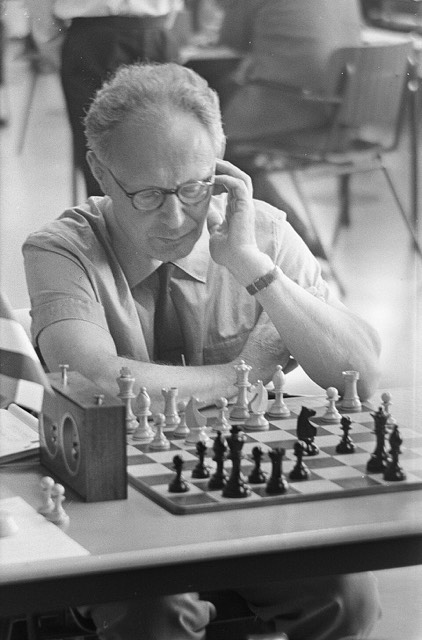
A Dutch press photo from 1966 labels him literally “dr. ir. M.M. Botwinnik,” doctor-engineer. He is the only world champion whose academic title precedes his chess title in a newspaper caption.
Three reigns
Alekhine died in 1946 holding the title. FIDE organised a tournament in 1948, in The Hague then Moscow, to find his successor: five players, each meeting each other five times. Botvinnik won with 14 points out of 20, three clear of Smyslov.
What follows is irregular, and that is what makes it interesting. He kept the title in 1951 against Bronstein and in 1954 against Smyslov, both times on a tied score — at the time the holder retained the title at 12-12. Smyslov took it from him in 1957, he took it back in 1958. Mikhail Tal took it in 1960, he took it back in 1961. Tigran Petrosian took it in 1963, for good.
Those two recoveries are unique in history. They rest on a clause known as the Botvinnik rule, granting the dethroned champion an automatic rematch. One point that matters: the clause had already been abolished before the 1963 match. He therefore entered that last match knowing he would get no second chance.
His method
The method is the real subject, and it is the part you can take home.
Botvinnik founded the Soviet school on a simple idea: talent is not enough, performance is built like an engineering project. From that he derived concrete practices, some of which look eccentric and are not.
He annotated every game in writing, including his losses, and published them. Publishing forbids self-indulgence: you do not grant yourself excuses in front of a reader.
He prepared his opening novelties in secret, then played training games against Vyacheslav Ragozin giving him only the starting position, never the analysis. He wanted to measure on a test subject the real surprise effect his opponent would face in a tournament. That is blind testing, applied to chess thirty years before the word protocol entered sporting vocabulary.
He asked Ragozin, a smoker, to fill the room with smoke during those games. He also played with the radio on. Botvinnik did not smoke and disliked noise: he conditioned himself deliberately, so that in a tournament he could tell himself he had prepared for it. Two hours of walking a day completed the programme.
Finally, he worked on typical positions rather than variations: recurring middlegame structures arising from his openings, with their associated plans. It is the direct ancestor of how players work on pawn structures today.
His school
He founded his chess school in 1963. Three of his pupils would become world champions: Anatoly Karpov, who joined at twelve, Garry Kasparov, who joined at ten in 1973, and Vladimir Kramnik, who met him in 1987 when Botvinnik was seventy-six.
Kramnik tells of arriving through an improbable channel: the postmaster of his town telephoned Botvinnik to tell him about the boy. He also testifies that, contrary to his reputation for a difficult character, Botvinnik was warm and funny with his students.
The counterpoint is delicious. His initial verdict on Karpov was catastrophic: the boy understands nothing about chess and has no future in this profession. He held Karpov’s taste for blitz against him. He changed his mind a few years later. On Kasparov at eleven, by contrast, he wrote that the future of chess lay in that young man’s hands.
His openings
Beware a common confusion: two things carry his name and have nothing to do with each other.
The Botvinnik Variation of the Semi-Slav is one of the most violent lines in the classical repertoire. After 1.d4 d5 2.c4 c6 3.Nf3 Nf6 4.Nc3 e6 5.Bg5 dxc4 6.e4 b5 7.e5 h6 8.Bh4 g5 9.Nxg5 hxg5 10.Bxg5, White has sacrificed a piece for a central steamroller, and Black keeps the pawn while accepting a shattered structure.
The Botvinnik System in the English Opening is the exact opposite: a calm developing scheme with c4, Nc3, g3, Bg2, d3, e4 and Nge2, playable against almost anything. Control and solidity, no immediate tactics.
His masterpiece
Rotterdam, November 1938, the AVRO tournament, against José Raúl Capablanca. Botvinnik has a passed pawn on e6 that Black’s queen is blockading. On move thirty he offers his bishop.
The queen takes, and the knight sacrifices itself in turn on h5. A mating net follows, conducted by the queen alone while the e-pawn marches towards promotion. Capablanca resigns on move forty-one.
Botvinnik regarded this as his masterpiece. A detail that puts things in perspective: he did not win the tournament. Keres and Fine finished ahead of him.
How you beat a tactical genius
Moscow, March 1961, game one of the return match against Tal. Botvinnik offers the queen trade as early as move eleven and walks his king to d1.
That is Botvinnik’s whole thesis in one move. You do not beat a genius of complications by following him into complications: you move him onto ground where his talent is useless. He won the match 13-8 and took his title back.
What you can steal from him
Annotate your own losses, in writing, before you run the engine. It is the most profitable and most boring transfer from his method. Writing down what you thought you were doing at the moment you played is the only way to see where your reasoning went wrong.
Train in competition conditions, not in comfort. On a real clock, sitting up, with noise around. Hence the radio and the cigarette smoke.
Work on typical positions rather than move lists. A pawn structure you understand serves you in fifty games; a memorised variation serves you in one. It is exactly Prologue’s bet.
Frequently asked questions
How many times was Botvinnik world champion?
Three: from 1948 to 1957, from 1958 to 1960 and from 1961 to 1963. He is the only player in history to have regained the world title twice, thanks to the automatic rematch clause in force until 1961. Alexander Alekhine, before him, had regained it once.
What is the Soviet school of chess?
It is the approach founded by Botvinnik, holding that chess performance is built methodically: written and published analysis of your own games, systematic opening preparation, study of opponents, training in degraded conditions and physical preparation. It dominated world chess for half a century.
Which world champions did Botvinnik train?
Three: Anatoly Karpov, who joined his school around the age of twelve in 1963, Garry Kasparov, who joined at ten in 1973, and Vladimir Kramnik, who arrived in 1987. Alexei Shirov, Vladimir Akopian and Jaan Ehlvest also came through it.
What is the Botvinnik Variation?
It is a very sharp line of the Semi-Slav Defence in which White sacrifices a piece for a crushing pawn centre after 5.Bg5 dxc4 6.e4 b5 7.e5 h6 8.Bh4 g5 9.Nxg5 hxg5 10.Bxg5. Do not confuse it with the Botvinnik System in the English Opening, which is a calm developing scheme and entirely unrelated.