
Tigran Petrosian
World champion from 1963 to 1969, nicknamed Iron Tigran and the supreme master of prophylaxis: Petrosian's career, style and openings.
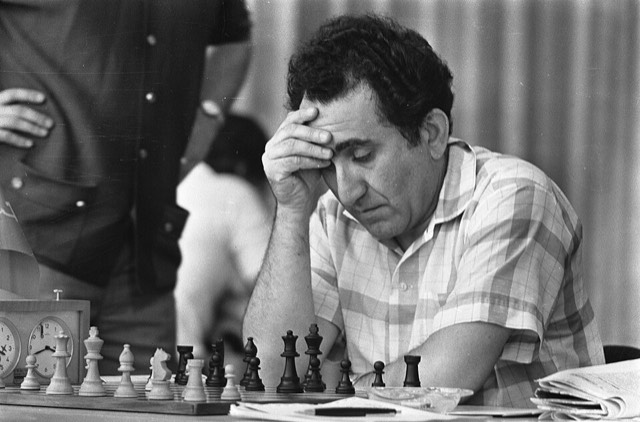
- Born
- June 17, 1929
- Died
- August 13, 1984
- Country
- USSR (Armenia)
- World champion
- 1963-1969
- Peak rating
- 2645 (1972)
Petrosian is the world champion a club player can most readily imitate, and that is a paradox: his game rests not on calculation but on a question he asked himself before every move. What does my opponent want to play? And how do I stop it?
From Tbilisi to the title
He was born in Tbilisi on 17 June 1929, into an Armenian family. Asked later about being called Russian abroad, he replied: abroad they call us all Russians; I am a Soviet Armenian.
Orphaned during the war, he swept streets to survive. His words: I started sweeping streets in the middle of winter and it was horrible, I was ashamed of being a street sweeper. He fell ill and lost a school year. It was in that period that his hearing began to fail, and it never recovered: he wore a hearing aid throughout his career.
As a teenager he bought a copy of Nimzowitsch’s Chess Praxis with his ration coupons. He would later say it was the single greatest influence on his chess life. He worked through My System later, from 1947.
He became world champion in 1963 by beating Mikhail Botvinnik 12½-9½. He kept the title in 1966 against Boris Spassky, 12½-11½, which is no small thing: he was the first champion since Alekhine in 1934 to defend the title by winning a match. Spassky took it from him in 1969, 12½-10½.
His team record is crushing and less well known. Across ten consecutive Olympiads he played 129 games and lost exactly one. One, in twenty years.
He died in Moscow on 13 August 1984, of stomach cancer.
Iron Tigran
Trained from the age of twelve by Archil Ebralidze, a disciple of Nimzowitsch and Capablanca who discouraged unsound combinations, Petrosian built a game that ran counter to everybody else’s. He spent more energy preventing his opponent’s possibilities than creating his own, and almost never attacked before his position was completely safe.
His reputation suffered. He was called boring, a drawing master, timid. His own reply is the best defence anyone could make for him:
They say my games should be more interesting. I could be more interesting — and also lose.
His peers were not fooled. Spassky: Petrosian reminds me of a hedgehog, just when you think you have caught him, he puts out his quills. And this more disquieting line: it is to Petrosian’s advantage that his opponents never know when he is suddenly going to play like Tal. The journalist Harold Schonberg found another image: playing him was like trying to put handcuffs on an eel, there was nothing to grip.
The exchange sacrifice
That is his real signature, and the most useful thing to take from him. Giving a rook for a bishop or a knight, not for an attack, but for purely positional reasons.
Kasparov analysed it better than anyone: Petrosian introduced the exchange sacrifice for the sake of quality of position, in configurations where the time factor, so important in the play of Alekhine and Tal, hardly matters at all. Even today, very few players can operate confidently at the board with such abstract concepts.
The reference game is this one, played at Zurich in 1953 against Samuel Reshevsky. Petrosian has Black.
Look at what he buys with that rook. The knight goes via e7 and lands on d5, a square no white pawn controls any more. White’s pawn centre, which looked threatening, is stopped dead. The b2 bishop becomes a spectator. Reshevsky, who was better, can no longer do anything and the game is drawn.
The lesson is easy to state and hard to accept: a rook is only worth more than a knight if it has open files. A knight on a strong square nothing can attack is often worth more than a rook doing nothing.
He could finish, too
To balance the boring reputation, here is how he concluded game ten of his 1966 match against Spassky.
Spassky had attacked on both wings. Petrosian sensed the danger before it existed, neutralised everything, then finished with a queen sacrifice. The boring player dispatches a future world champion in thirty moves.
His openings
The Petrosian System in the King’s Indian Defence consists of closing the centre early with d4-d5, which smothers Black’s dynamic counterplay. It is prophylaxis in the form of an opening. He also left his name to a Queen’s Indian line, with 4.a3 to prevent the pin, which Kasparov brought back into fashion in 1980.
With Black he played the Caro-Kann and the French Defence, closed openings that committed his pieces to no forced plan. He gave his name to variations of both.
What you can steal from him
Ask his question before every move: what does my opponent want to play? Then stop it, rather than pushing your own plan. It is the only world champion’s style directly copyable by an amateur, because it does not require calculation, it requires a question.
Look at your exchanges differently. You are not trading material, you are trading quality of position. A passive rook for an ideally posted knight is a good deal, whatever the point count says.
And accept that not losing is a strategy. Over a club season, being hard to beat scores more points than intermittent brilliance. It is also the habit Prologue builds: a plan you hold from start to finish, rather than a series of brilliant moves that lead nowhere.
Frequently asked questions
Why was Petrosian nicknamed Iron Tigran?
For his solidity and his extraordinary ability not to lose. He was unbeaten at the Interzonal tournaments of 1952 and 1955 and conceded no losses at all in tournament play during 1962. Across ten consecutive Olympiads and 129 games, he lost only one.
What is a positional exchange sacrifice?
It is giving up a rook for a bishop or knight with no immediate tactical compensation, purely for structural reasons: blocking a centre, installing a knight on a strong square, neutralising an enemy piece. Petrosian made it his signature, and Kasparov notes he was the first to study the concept seriously.
What is prophylaxis in chess?
It is preventing your opponent’s plans before they can be launched, rather than developing your own. The term comes from Nimzowitsch, whose most faithful heir Petrosian was. In practice it means identifying your opponent’s best move and making it impossible.
How did Petrosian lose his title?
He lost it in 1969 to Boris Spassky, 10½ to 12½, three years after beating him in their first match of 1966. That 1966 win had made him the first world champion since Alekhine in 1934 to retain the title by winning a match.