
Mikhail Tal
World champion in 1960 at twenty-three, known as the magician from Riga: Mikhail Tal's career, style and sacrifices.
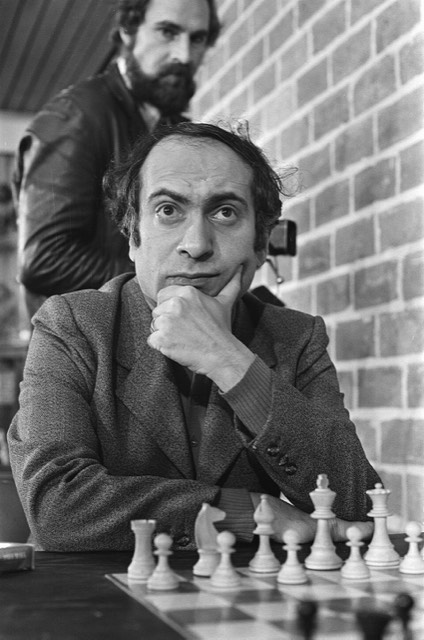
- Born
- November 9, 1936
- Died
- June 28, 1992
- Country
- USSR (Latvia)
- World champion
- 1960-1961
The story goes that Tal sacrificed anything, at any moment, and that it worked by magic. It is a good story and it is false. What he actually did was more interesting: he optimised the position his opponent had to solve, not the position itself.
The magician from Riga
He was born on 9 November 1936 in Riga, into a Jewish family. He came into the world with a congenital malformation of his right hand, leaving him only three fingers.
His health weighed on his entire career. Chronic kidney problems, an acute crisis at Curaçao in 1962 that forced him to withdraw from the tournament and be hospitalised, the removal of a kidney in 1969. He smoked and drank heavily. He died in Moscow on 28 June 1992, aged fifty-five.
In 1960 he beat Mikhail Botvinnik 12½-8½ and became world champion at twenty-three, the youngest in history at that point. The record stood for twenty-five years, until Kasparov.
The 1961 rematch went badly: Botvinnik took the title back 13-8. Tal explained why without looking for excuses. Botvinnik had spent the year dissecting his play and knew it better than Tal knew Botvinnik’s. His health did not help — the Riga doctors advised postponing the match, and he chose to play, thinking he would win anyway. His verdict: Botvinnik’s victory was deserved.
The rest of his career was longer than people remember. Six Soviet championships, level with Botvinnik’s record. And above all a run of ninety-five consecutive games without defeat between October 1973 and October 1974, including forty-six wins. That is not a string of cautious draws, it is a string of victories.
His sacrifices, honestly
The line attributed to him — there are two types of sacrifices, correct ones and mine — has no identifiable primary source, but it says something true.
Many of his sacrifices do not survive modern analysis. Engines find refutations. But studying his games shows something else: his practical evaluations were almost always right. He was not playing at random and hoping. He chose the position his opponent would have to solve on the clock, knowing it was objectively dubious and humanly unplayable.
His most famous quotation, about the deep dark forest where two plus two makes five, circulates in a version no source confirms. The documented version, relayed by Kasparov, runs: nowadays both players often deliberately deviate from generally recognised laws, entering a dense forest of unexplored variations, on a narrow mountain path where there is room for only one. Less punchy, and more accurate.
The move that did not win
Moscow, 1960, game six against Botvinnik. On move twenty-one Tal plants his knight on f4, where it can be taken.
Botvinnik takes the knight and loses the game. We now know 23.a3 was available and refuted the whole idea. He did not see it. That is exactly Tal’s thesis: the move was not winning, it was impossible to refute across the board, on the clock, in real time.
And the one that did win
Bled, 1965, Candidates match against Bent Larsen, game ten, the decisive game of the match. On move sixteen Tal gives up a knight on d5.
Larsen takes, and the attack arrives. Tal wins the game and the match, and qualifies for the Candidates final.
His openings
An honest caveat: the sources claiming to list his favourite openings are mostly low quality. What his games show, by contrast, is clear.
He played the Sicilian Defence from both sides, and the King’s Indian Defence against 1.d4, two openings producing the unbalanced positions where his talent showed. He also liked the Modern Benoni, a structural cousin of the King’s Indian, despite its strategically dubious reputation. With maturity his repertoire broadened towards more classical systems.
The two stories to keep
The first he tells himself. In the middle of a Soviet championship, complex position, knight sacrifice in view. The audience thinks he is deep in calculation. In reality he is turning over the closing lines of a children’s poem by Chukovsky: what a difficult job it is to drag a hippopotamus out of the marsh. He considers jacks, levers, a helicopter, a rope ladder, then gives up and decides the hippopotamus can drown. He returns to the board, admits the variations are incalculable, plays the sacrifice on pure intuition, and wins. After forty minutes of thought.
The second is the last. On 28 May 1992, dying, Tal escaped from hospital to play a blitz tournament in Moscow. He beat Kasparov in seventeen moves, the world champion’s only loss of the event. He died a month later.
One correction in passing, because it circulates the wrong way round: Tal did win the world blitz championship in 1988 at fifty-one, but by beating Vaganian in the final. Kasparov had been knocked out earlier by another player.
What you can steal from him
It is not “sacrifice more often.” It is three more useful things.
Risk is measured in clock time, not in hundredths of a pawn. A slightly inferior move that forces your opponent into twenty minutes of exact calculation beats a neutral move that plays itself. Botvinnik had the refutation on the board and did not find it.
Knowing when to stop calculating is a skill. The hippopotamus story says exactly that: Tal understood he could not calculate everything and decided on judgement rather than burning his clock.
And intuition is not luck. His evaluations, even in objectively dubious positions, were sound. That is capital built over thousands of games. It is what Prologue tries to accelerate: seeing the intention of a position rather than calculating it move by move.
Frequently asked questions
Why was Mikhail Tal called the magician from Riga?
For his attacking style based on intuitive sacrifices and deliberate complications, in positions his opponents could not untangle on the clock. He came from Riga, in Latvia, then a Soviet republic.
Were Tal’s sacrifices sound?
Often not, in the sense modern engines use, since they find refutations to many of them. But his practical judgement was sound: he chose positions that were objectively dubious and extremely hard for a human to defend. His most famous sacrifice, against Botvinnik in 1960, was refutable by 23.a3, which Botvinnik did not find.
How long was Tal world champion?
One year, from 1960 to 1961. He had beaten Botvinnik 12½-8½ at twenty-three, becoming the youngest world champion in history at that date. Botvinnik took the title back the following year through the automatic rematch, 13 to 8.
What is Tal’s longest unbeaten streak?
Ninety-five consecutive games, between 23 October 1973 and 16 October 1974, with forty-six wins and forty-nine draws. He also held the second longest streak of the era, eighty-six games in 1972-73. Ding Liren passed the record in 2018, but with far more draws.