
Anatoly Karpov
World champion from 1975 to 1985, record holder for tournament wins and master of positional pressure: Karpov's career and style.
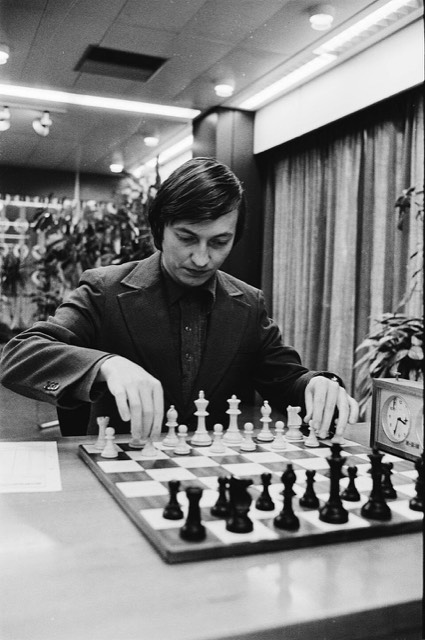
- Born
- May 23, 1951
- Country
- USSR, then Russia
- World champion
- 1975-1985, FIDE 1993-1999
- Peak rating
- 2780 (1994)
Karpov became world champion without playing a move, and spent the next ten years proving he deserved it. He is probably the champion whose method transfers most directly to an average player, because it does not rest on calculation.
The title he was handed
He was born on 23 May 1951 in Zlatoust, in the Urals. Soviet master of sport at fifteen, world junior champion in 1969, grandmaster in 1970.
In 1975 he won the Candidates cycle and became the legitimate challenger to Bobby Fischer. Fischer rejected the match format and set conditions FIDE would not accept. He did not turn up. On 3 April 1975, Karpov was declared world champion without having played.
He is the only champion in history never to have beaten his predecessor, and he would never meet Fischer. His answer to that legitimacy gap is spectacular: he entered almost every major tournament for ten years, something no champion had done before. Fischer, by contrast, hardly played at all. The consensus formed quickly, not by decree but by accumulation of results.
He defended the title twice against Viktor Korchnoi, who had been granted political asylum in the Netherlands in 1976. Baguio 1978 was played in a poisonous atmosphere: a Soviet parapsychologist sitting in the front row staring at Korchnoi for hours, and a written protest from the opposing camp about the colour of the yoghurt served to Karpov, suspected of carrying a code. Karpov won six wins to five. Merano 1981 was a demolition, six to two.
The five matches against Kasparov
They played one hundred and forty-four games against each other. The first match, in 1984-85, is the strangest in world championship history.
Unlimited format, first to six wins. Karpov led 5-0 after twenty-seven games. He needed one more win. He never found it. Twenty-one games without a win, during which Garry Kasparov took game thirty-two, then games forty-seven and forty-eight. On 15 February 1985, after five months and forty-eight games, the FIDE president stopped the match with no result, at 5-3, citing the health of both players. An unprecedented decision, contested by both camps.
The new match started from zero in 1985 and Karpov lost his title. He would fail to regain it in 1986, 1987 and 1990. Seville 1987 was the cruellest: he led 12-11 going into the last game and a draw was enough. Kasparov won that game, levelled at 12-12, and kept his title.
After the 1993 split, Karpov held the FIDE title until 1999. His peak rating of 2780 dates from July 1994. He spent one hundred and two months in total as world number one.
Today, at seventy-five, he has been a deputy in the State Duma since 2011. Since 2022 he has appeared on the sanctions lists of the European Union and several other countries, following his vote in favour of recognising the Donbas republics.
The boa constrictor
The nickname is the most accurate ever attached to a player. Karpov does not attack, he tightens. He accumulates micro-advantages, progressively reduces his opponent’s space and methodically deprives him of all counterplay. That is the central notion with him: where most grandmasters look to create threats, Karpov looks first to remove the other side’s. The opponent does not lose to a move, he discovers he has nothing left to play.
His own formulation says everything:
Let us say the game may continue in two ways: one is a beautiful tactical blow that gives rise to variations that do not yield to precise calculation; the other is clear positional pressure that leads to an endgame with microscopic chances of victory. I would choose the latter without thinking twice.
His moves taken separately look modest, almost timid. They are tidying moves: reposition a bishop, double rooks, lock down a square. Seen individually they do not impress. Seen across forty moves, they form a vice.
His real calling card is tournaments. More than one hundred and sixty first places according to the most cited counts, roughly double Kasparov’s over a comparable span. The summit is Linares 1994: at forty-two, he finished unbeaten with 11 points out of 13, two and a half points ahead of Kasparov and Shirov. His performance, estimated at 2985, is regarded by the statistician Jeff Sonas as the best in the history of chess.
The buried bishop
Nice Olympiad, 1974, against Wolfgang Unzicker. Karpov freezes the queenside, then plays the most taught twenty-fourth move in his repertoire.
Unzicker has all his pieces on the board and not one useful move. Karpov then switches wings and finishes. No combination, no sacrifice: the opponent resigns because he is suffocating.
He could strike, too
For balance, here is Linares 1994 against Veselin Topalov, a game known as Karpov’s Immortal. Topalov weakens his dark squares on move fourteen. Karpov gives up a rook on move twenty-one.
He gives up a second rook on move twenty-eight and hunts the black king down to resignation. The player everyone calls purely positional produced one of the finest attacking games of the 1990s.
His openings
The Karpov Variation of the Nimzo-Indian Defence carries his name and is still widely played: it leads to an isolated queen’s pawn structure and pure manoeuvring, exactly his ground.
With Black, the Caro-Kann is the weapon best suited to his style. He notably played it in all six of his black games in the 1987 Candidates final against Sokolov, without losing once. With White he turned the Ruy Lopez into a classic instrument of strangulation.
What you can steal from him
He is the only great champion whose method requires no calculation. Before looking for your best move, look for your opponent’s best plan, and remove it. That is the point of a4 and b4 against Unzicker: Karpov builds nothing, he locks the wing where his opponent was going to play.
The practical corollary is even simpler. In a position where you see nothing strong, do not force it. Improve your worst-placed piece and take one option away from your opponent.
A club player rarely loses because they missed a combination. They lose because they let their opponent get play. Karpov proves you can win without ever attempting anything spectacular, simply by conceding nothing. That is also what Prologue tries to install: an opening whose plan you know, not just its moves.
Frequently asked questions
Did Karpov and Fischer ever play each other?
Never. Karpov won the 1975 Candidates cycle and was due to face Fischer, but Fischer rejected the format proposed by FIDE and did not appear. Karpov was declared world champion by forfeit on 3 April 1975, without playing a single move, and the two never met in competition.
What happened in the 1984-85 Karpov-Kasparov match?
The match, with no game limit, was to run until six wins. Karpov led 5-0 after twenty-seven games, then failed to win for twenty-one games while Kasparov won three. On 15 February 1985, after forty-eight games and five months, the FIDE president stopped the match with no result at 5-3. A new match was played from scratch later that year, which Karpov lost.
What is Anatoly Karpov’s playing style?
Methodical positional pressure: he accumulates small advantages and above all deprives his opponent of any counterplay, until they have no useful move left. He is often compared to a boa constrictor. He explicitly preferred endgames with a minimal edge over tactical complications.
How many tournaments did Karpov win?
More than one hundred and sixty first places according to the most frequently cited counts, an order of magnitude no body officially certifies. His peak remains Linares 1994, won unbeaten with 11 points out of 13 and a two-and-a-half point margin, for a performance estimated at 2985.