
Garry Kasparov
World champion from 1985 to 2000, world number one for 255 months and the man who played Deep Blue: Garry Kasparov's career, style and openings.
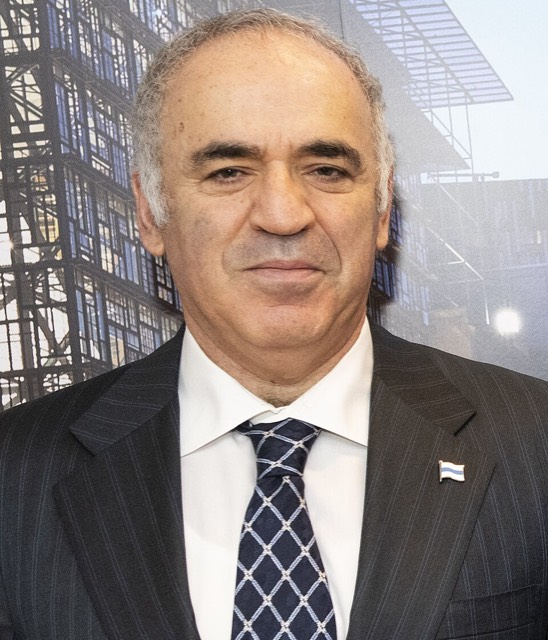
- Born
- April 13, 1963
- Country
- Russia
- World champion
- 1985-2000
- Peak rating
- 2851 (1999)
Most people remember Kasparov as the man who lost to a computer. That is a shame, because the real story is elsewhere: he was the first player to treat opening preparation as laboratory work, and he ruled for twenty years with that method.
From Baku to the top
Garik Weinstein was born in Baku, in the Azerbaijan Soviet Socialist Republic, on 13 April 1963. He took his mother’s name, Kasparova, russified to Kasparov, after his father died. At ten he entered Mikhail Botvinnik’s school. The old champion summed up his first impression of an eleven-year-old: “Garry’s speed and memory capacity are amazing. He counts deep variations and finds unexpected moves.”
Grandmaster in 1980. His first world championship match against Anatoly Karpov, in 1984-85, was abandoned after forty-eight games with no winner, with Karpov ahead. The rematch later that year ended 13-11 to Kasparov. He was twenty-two, the youngest undisputed world champion in history, a record that stood until 2024.
He held the title for fifteen years, holding off Karpov three more times: two wins and a draw snatched in the very last game at Seville 1987. In 1993 he and his challenger Nigel Short rejected FIDE’s terms and founded a rival body, the PCA, splitting the title in two for thirteen years. He lost it in 2000 to Vladimir Kramnik, 8½-6½, without winning a single game of the match. He left competition in March 2005, after winning Linares one last time.
His peak rating of 2851, in July 1999, stood as the world record until Carlsen passed it in 2013. He spent 255 months as world number one.
Deep Blue, and what gets told wrong
In February 1996, in Philadelphia, he beat IBM’s machine 4-2. In May 1997, in New York, he lost the rematch 3½-2½. It was the first time a machine had beaten a reigning world champion over a full match.
The part that gets told less often: in game two of 1997 he resigned a position that was drawn. He only found out the next morning, when friends showed him that 45…Qe3 forced perpetual check. He never recovered during the rest of the match. The legend of the unbeatable machine rests partly on a player who fell apart.
A year later, in June 1998 in León, he invented advanced chess: human plus engine against human plus engine. It is the direct ancestor of how everyone works today. He had already brought one of the first Western microcomputers back to Baku, in 1983.
His style: initiative before material
Kramnik, who beat him, called him “a chess player with virtually no weaknesses.” Botvinnik compared his combinational vision to Alekhine’s. Kasparov himself named Alekhine, Tal and Fischer as his influences.
What really set him apart was preparation. Where his rivals knew lines, he manufactured them, in advance, in writing, with a database. Frederic Friedel gave him a copy of ChessBase in 1987 and he became the first player to industrialise computer-assisted analysis. Grandmaster Sergey Shipov points to the cost of that approach: impulsiveness, and a trust in calculation that sometimes tipped into exhaustion.
His openings
With Black he played the Sicilian Defence almost exclusively against 1.e4, first the Scheveningen and later the Najdorf. Against 1.d4 he started with the King’s Indian Defence before drifting towards the Grünfeld and the Nimzo-Indian in the second half of his career.
With White, his most striking contribution was reviving the Scotch Game. A nineteenth-century opening written off as obsolete, which he brought back against Karpov in 1990, then against Short and against Anand. It was not better than the fashionable theory. It was simply unknown to his opponents. He also gave his name to a line of the Queen’s Indian, and happily played the Queen’s Gambit.
Two positions that explain him
The octopus knight
Moscow, 1985, game sixteen of the title match. Kasparov has Black against Karpov. He has sacrificed a pawn in the opening to plant a knight on d3.
The knight paralyses every one of Karpov’s heavy pieces. It cannot be taken and it cannot be driven off, and it sits there for eighteen moves. Karpov eventually gave up his queen to remove it, too late. The term octopus knight comes from this game.
The Immortal
Wijk aan Zee, January 1999, against Veselin Topalov. On move twenty-four, Kasparov gives up his rook.
The black king starts on a7 and runs aground on e1, at the far end of the board. Modern engines, for what it is worth, think 24…Kb6, declining the rook, held better. So the combination is not perfect. It remains one of the finest ever played by a human on the clock.
What you can steal from him
Write your opening preparation down. Kasparov did not know more lines than his rivals, he had worked them out in advance and recorded them. A club player who documents three main openings in one file improves faster than one grinding random tactics.
Reviving an old opening is a real strategy. The Scotch was not objectively better, it was unfamiliar to the opponent. At your level, a well-prepared sideline beats a fashionable opening you half understand.
A knight on a square no enemy pawn can attack is often worth more than a pawn. Game sixteen of 1985 proves it for eighteen moves.
That is exactly what Prologue tries to give you: not a list of moves, but the intention behind each one, so your preparation still holds when your opponent leaves the line.
Frequently asked questions
How long was Garry Kasparov world champion?
Fifteen years, from 1985 to 2000. He held the FIDE title from 1985 to 1993, then the PCA classical title from 1993 to 2000, after the split he caused with Nigel Short. Vladimir Kramnik took the title from him in 2000.
Did Kasparov really lose to Deep Blue?
Yes, but only once. He won the first match in 1996 by 4-2 and lost the 1997 rematch by 3½-2½. In game two of 1997 he resigned a position that was in fact drawn, which shook him for the rest of the match.
What was Kasparov’s peak rating?
2851, reached on the FIDE list of July 1999 and held in January 2000. That world record stood until 2013, when Magnus Carlsen passed it. Kasparov also spent 255 months as world number one.
What openings did Garry Kasparov play?
With Black, the Sicilian Defence against 1.e4, first the Scheveningen then the Najdorf, and the King’s Indian and later the Grünfeld against 1.d4. With White he brought the Scotch Game back into top-level play and developed a Queen’s Indian line that carries his name.