
Judit Polgár
Grandmaster at 15, the only woman ever to reach the world top 10 and the player who beat eleven world champions: Judit Polgár's career and style.
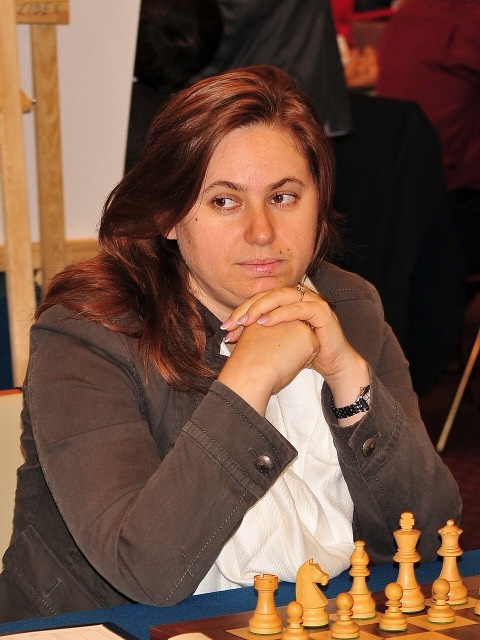
- Born
- July 23, 1976
- Country
- Hungary
- Peak rating
- 2735 (2005)
Judit Polgár is the only woman who has ever reached the world top 10, and the only one to pass 2700 rating points. She never once played in a women’s world championship. Those two facts are connected, and together they are her whole story.
An educational experiment that became a career
She was born in Budapest on 23 July 1976. Her father, László Polgár, was an educator out to prove a thesis: geniuses are made, not born. He raised his three daughters at home around a single discipline, chess. They learned Esperanto too. Zsuzsa, the eldest, became a grandmaster and women’s world champion. Zsófia, the middle sister, an international master.
Judit was the youngest, and she went furthest. In December 1991, winning the Hungarian championship, she earned the grandmaster title at fifteen years and four months. That beat Bobby Fischer’s precocity record, which had stood for thirty-three years, by roughly a month.
In early 1993, aged sixteen, she played an exhibition match against Boris Spassky in Budapest and won 5½-4½. She reached her peak rating of 2735 in July 2005 and her best world ranking, eighth, in January 2004. She was the world’s top-ranked woman continuously from January 1989 to March 2015 — outlasting even her August 2014 retirement — twenty-six years.
FIDE counts eleven world champions she has beaten in classical or rapid play: Carlsen, Karpov, Kasparov, Kramnik, Spassky, Smyslov, Topalov, Anand, Ponomariov, Khalifman and Kasimdzhanov. She is also the only woman to have played in a World Chess Championship tournament of any kind, at San Luis in 2005.
She retired in August 2014, during the Tromsø Olympiad, where she was playing as a reserve on Hungary’s open team. She scored 4½ out of 6 and left with a silver medal. Ten months later she became captain and head coach of that same team. Since 2015 she has run the Global Chess Festival in Budapest every year, and her Chess Palace education programme is part of the Hungarian national curriculum.
Her style: aggression, then technique
Kasparov summed up her reputation in one line: if “playing like a girl” meant anything in chess, it would mean relentless aggression.
True, and incomplete. As a teenager she helped bring the Bishop’s Gambit back into fashion, and she went looking for complications. But her biggest scalp, the win over Kasparov, owes everything to is an endgame won by accumulating small advantages. That gap between the reputation and the actual record is the most interesting thing about her.
She says herself that chess is “30 to 40% psychology.” Choosing a line the opponent knows too well is part of the arsenal, as we are about to see.
Her openings
With White, 1.e4 almost always, with the Ruy Lopez as her main weapon. Against the Najdorf she developed an anti-Najdorf system with 6.Be3, built entirely around winning the d5 square. ChessBase devoted a whole article to the plan.
With Black, the Sicilian Defence and the King’s Indian Defence. An attacking player’s repertoire, never softened towards neutral systems.
The attack: Bled 2002
Bled Olympiad, October 2002. She has White against Shakhriyar Mamedyarov, seventeen years old and a future world number two. On move twelve she takes on f7.
What follows only looks spectacular: the hunt is forced for eleven moves. The black king starts on e8 and ends up on d5, deep in White’s half. Mamedyarov resigned after 23.Be7+ Kd5 rather than wait for the mate, which came via 24.Qf3+ Kc4 25.b3.
The technique: Moscow 2002
A month and a half earlier, at the Russia versus the Rest of the World match in Moscow. A rapid game, and she has White against Kasparov, the reigning world number one. It is the first time in history that a woman beat the world number one in competition.
One detail is worth the trip: Kasparov plays the Berlin, and Polgár picks a line against him that Kasparov himself had used against Kramnik. She beat him with his own preparation.
Queens come off on move eight. There is no attack, just a black king stuck awkwardly in the centre and two rooks that eventually settle on the seventh rank.
Kasparov resigned three moves later. “This victory is one of the absolute highlights of my career,” she said.
The backstory makes the game better. Eight years earlier at Linares, Kasparov had played a move against her, let go of the piece, then picked it up again and put it somewhere else. A camera showed his fingers had left the piece for about a quarter of a second, enough for the touch-move rule to apply. The arbiter said nothing. He won the game. She was seventeen, and they did not speak for three years.
What you can steal from her
Play the positions you like, not the ones you think you are supposed to play. She built an entire career on 1.e4 and the Sicilian without ever drifting towards safer systems.
A sacrifice is not a gamble. At Bled, the move on f7 only looks pretty: the hunt is calculated eleven moves deep. If you cannot see the forcing sequence, it is not a sacrifice, it is a hope.
Technique pays as well as attack. Her finest win, against Kasparov, is an endgame. That is counterintuitive given her reputation, which is exactly why it is worth remembering.
And the opening choice is already a psychological weapon: playing someone’s own line against them takes away their preparation edge. Prologue works in that direction too, showing you the intention behind each move rather than a list to memorise.
Frequently asked questions
Is Judit Polgár the best female chess player in history?
That is the general view, and in September 2024 FIDE gave her its award for the best woman player of the last hundred years. She is the only woman to have reached the world top 10, the only one to have passed 2700 rating points, and she was the top-ranked woman in the world for twenty-six consecutive years.
Why did Judit Polgár never play the women’s world championship?
By choice. She always refused to play in women-only events, preferring to measure herself directly against the best players in the world. She eventually called publicly for women’s titles to be abolished. Her eldest sister Zsuzsa did win the women’s world championship, in 1996.
Did Judit Polgár beat Kasparov?
Yes, in September 2002 in Moscow, at the Russia versus the Rest of the World match, in a rapid game. It was the first time a woman had beaten the reigning world number one in competition. In total she has beaten eleven world champions, including Carlsen, Karpov, Kramnik, Spassky and Anand.
How old was Judit Polgár when she became a grandmaster?
Fifteen years and four months, in December 1991, by winning the Hungarian championship. That beat the precocity record Bobby Fischer had held since 1958, which was fifteen years, six months and one day, by roughly a month.