
Viswanathan Anand
Five-time world champion, India's first grandmaster and founder of the academy that produced Gukesh: Anand's career and style.
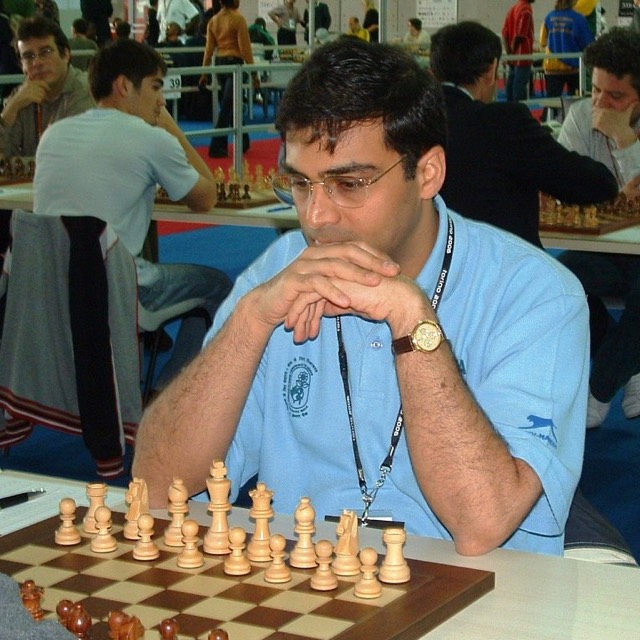
- Born
- December 11, 1969
- Country
- India
- World champion
- 2000-2002, 2007-2013
- Peak rating
- 2817 (2011)
In 1988, India had exactly one grandmaster: him. In 2026 it has more than eighty-five, and the reigning world champion came out of his academy. That is probably the most measurable legacy of anyone on this list.
The Tiger of Madras
He was born on 11 December 1969 in Tamil Nadu and grew up in Madras, now Chennai. His mother, Sushila, taught him chess.
In the 1980s he was called the lightning kid for his speed of play, long before anyone called him the Tiger of Madras. In 1988 he became the first grandmaster in India’s history. At twenty-two, he won Reggio Emilia 1991/92 ahead of Kasparov and Karpov, the world champion and his predecessor.
He has been world champion five times, and the mix of formats is worth spelling out because it says something about his range. In 2000 he won the FIDE title by beating Shirov in a knockout. In 2007 he became undisputed champion by winning a tournament in Mexico City — the first since Botvinnik in 1948 to take the title through a tournament rather than a match. He then defended it in matches three times: against Vladimir Kramnik in 2008, Topalov in 2010 and Gelfand in 2012.
The journalist Lubomir Kavalek summed up what makes him singular: Anand is the only player to have won the world title in tournament format, match format, knockout format and at rapid time controls. One claim in circulation is simply false: he has never won the FIDE world blitz championship. He has, however, been world rapid champion twice, in 2003 and 2017, fourteen years apart.
Magnus Carlsen ended his reign, in Chennai in 2013 and Sochi in 2014.
His peak rating of 2817 dates from March 2011. He is now FIDE deputy president, elected in 2022, and he still plays: at fifty-six he remains in the world top fifteen.
The Anand effect
This is the strongest part of his story. After his grandmaster title in 1988, Indian progress was slow: three grandmasters in ten years. Today there are more than eighty-five.
In December 2020, Anand founded an academy bearing his name with the WestBridge Capital fund, with Boris Gelfand and Artur Yusupov among the coaches. The first intake, in January 2021, included Gukesh Dommaraju, Praggnanandhaa, Nihal Sarin, Vaishali and Raunak Sadhwani. Arjun Erigaisi joined a few months later.
Four years after that first intake, Gukesh is world champion. The Indian press talks about the Anand effect, which is a journalist’s phrase rather than a measured concept, but the link is direct and documented.
His style
The best-established trait is speed. He played his games considerably faster than average, and that is not a legend: it earned him his first nickname.
His own description of his method is the most useful thing to keep. Anand calls himself an intuitive player and defines intuition as the first move he sees in a position. Calculation comes afterwards, to check.
Beyond those two points, be careful: most descriptions of his style come from weak secondary sources. What is verifiable is that he crossed three eras of the game — before computers, the engine era, then neural networks — while staying at the top, which implies an uncommon capacity to adapt.
His immortal
Wijk aan Zee, January 2013. Anand has Black against Levon Aronian in a Semi-Slav, the sharper cousin of the Slav Defense. On move sixteen he plays a quiet move worth three pieces.
Aronian resigned on move twenty-three. Chess.com ranks the game third best of all time, behind Kasparov’s Immortal and the Opera Game.
Seventeen moves
Moscow, May 2012, game eight of the world championship against Boris Gelfand. It is the shortest decisive game in world championship history.
The best part: the grandmasters commentating live, Peter Leko and Ian Nepomniachtchi, preferred Black’s position and had not seen 17.Qf2. Nor had Gelfand. Anand explained that he first considered 17.Qf4 before refining it to 17.Qf2.
What you can steal from him
Speed can be trained. Anand’s founding trait is fast calculation, and it comes from an enormous volume of rapid games played in childhood, not from some mysterious gift. Playing plenty of rapid games is a method, not a waste of time.
Do not lock yourself into a fortress repertoire. Anand survived three technical revolutions in the game because he changed openings. A club player who has played the same thing for ten years plateaus for the same reason.
Trust your first move, then check it. That is literally his method, and it is far more efficient than reviewing every legal move.
Prologue drills exactly that reflex: recognising the idea of a position at a glance, then being able to justify it.
Frequently asked questions
How many times was Anand world champion?
Five times: in 2000 in FIDE’s knockout format, in 2007 by winning the Mexico City tournament, then by defending the title in matches against Kramnik in 2008, Topalov in 2010 and Gelfand in 2012. He lost the title to Magnus Carlsen in 2013.
Has Anand been world champion in every format?
Almost. He is the only player to have won the world title in tournament format, match format, knockout format and at rapid time controls. He has never, however, won the FIDE world blitz championship, contrary to what is sometimes written.
What is Anand’s role in the rise of Indian chess?
He was India’s first grandmaster in 1988, at a time when the country had none. India now has more than eighty-five. In 2020 he founded an academy whose first intake included Gukesh Dommaraju, world champion since 2024, along with Praggnanandhaa and Nihal Sarin.
What is Anand’s best game?
His win with Black over Levon Aronian at Wijk aan Zee in January 2013, in a Semi-Slav, often called Anand’s Immortal. Chess.com ranks it among the three finest games in the history of chess.