
Magnus Carlsen
World champion from 2013 to 2023, world number one since 2011 and holder of the highest rating ever: Magnus Carlsen's career, style and openings.
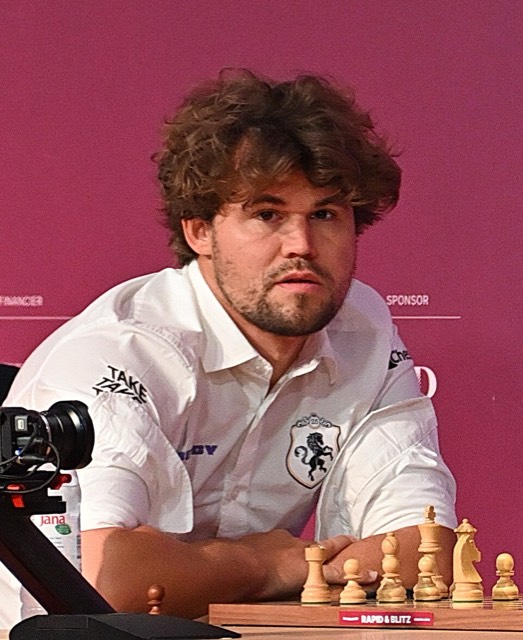
- Born
- November 30, 1990
- Country
- Norway
- World champion
- 2013-2023
- Peak rating
- 2882 (2014)
There are two ways to tell the Magnus Carlsen story. One is a list of records, and it is genuinely impressive. The other is more useful if you play chess yourself: he is the player who wins the games everyone else agrees to draw.
A prodigy who never left the top
Carlsen was born in Tønsberg, Norway, on 30 November 1990. By the age of five he had memorised the area, population, capital and flag of every country in the world. That same memory for patterns is what lets him recognise a pawn structure he last saw ten years ago.
He earned the grandmaster title in 2004, aged thirteen years and four months. That same year in Reykjavik, the boy held Kasparov to a draw in a rapid game before losing the second. Five years later, Kasparov became his coach.
Since 1 July 2011 he has not dropped off the top of the world rankings once. Fifteen years without interruption. He took the world title from Anand in 2013, then defended it against Anand again, against Karjakin, against Caruana, against Nepomniachtchi.
Then in 2022 he announced he would not defend it again. The distinction matters: he did not lose the title, he gave it up, saying the format no longer motivated him. Ding Liren succeeded him in 2023, then Gukesh in 2024. Carlsen stayed world number one. That is his position today, and it is a strange one: he left the crown without leaving the summit. In 2026 he added a Chess960 world title to the collection, beating Caruana in the final.
His style: winning what others draw
Kasparov places him with Karpov and Capablanca rather than with himself. His 2013 line is still the best description anyone has produced: “Carlsen is a combination of Karpov and Fischer. He gets his positions and then never lets go of that bulldog bite. Exhausting for opponents.”
Carlsen says he prefers the middlegame, because that is where it becomes “pure chess.” He is not being coy. His edge comes from apparently dead positions where he keeps setting small problems while his opponent gets tired. The usual word for it is grinding. In practice: he does not offer the draw, he plays another twenty moves, and he waits for the inaccuracy.
None of which means he cannot attack. The first game below should settle that.
His openings
Carlsen is the only player at the top who regularly opens with all four main first moves: 1.e4, 1.d4, 1.c4 and 1.Nf3. It is a deliberate choice. Varying takes opponents out of their preparation and gets him to the middlegame, which is where he wants to be.
With White he returns often to the Ruy Lopez and the English Opening, the latter especially at faster time controls. He will also play the London System to steer the game into a quiet positional fight and squeeze out a tiny edge.
With Black his most frequent answer to 1.e4 is the Berlin Defence, chosen precisely because it leads to the long endgames where his technique shows. He also plays the Sicilian Defence, including the Sveshnikov variation that was his main weapon in the 2018 match against Caruana.
Two positions that explain him
The thirteen-year-old
Wijk aan Zee, January 2004, group C. Carlsen is thirteen and facing Sipke Ernst in a Caro-Kann. On move eighteen he puts his knight on g6, a square watched by the f7 pawn.
A bishop sacrifice and a rook sacrifice follow, and mate arrives on move twenty-nine. It was while looking for a headline for this game that the journalist Lubomir Kavalek coined the nickname “the Mozart of chess.” The nickname and the game are the same object.
The grind
Chennai, November 2013, game six of the world championship. Carlsen has Black against Anand. The rook endgame that appears after move forty is drawn, and everybody knows it. Carlsen plays twenty more moves. On move sixty, Anand cracks.
This game swung the match, and it set his reputation for the next decade. He did not win with a combination. He won because he was still playing.
What you can steal from him
Do not offer a draw in a level position. That is the first lesson and the one worth the most rating points at club level, where endgames are played far worse than they were in Chennai. Playing another twenty moves is a skill, not stubbornness.
Work on rook endgames. It is the phase amateurs neglect most, and it is exactly the ground Carlsen dominates.
Vary your openings instead of drilling a single one to death. You will take opponents out of preparation more often, and you will reach middlegames you actually understand.
That is how Prologue approaches it. Rather than making you memorise move lists, the app has you replay each opening while showing the intention behind the move. When your opponent leaves the known line, you still have the plan.
Frequently asked questions
Is Magnus Carlsen still world champion?
No. He was world champion from 2013 to 2023 and then chose not to defend the title. Ding Liren succeeded him in 2023 and Gukesh Dommaraju became champion in 2024. Carlsen never lost the title over the board: he relinquished it, while remaining world number one on the rating list.
What is Magnus Carlsen’s rating record?
His peak is 2882, reached on the FIDE list of 1 May 2014 and matched again in August 2019. It is the highest rating in the history of chess. It beat Garry Kasparov’s previous record of 2851, which had stood since 1999.
What openings does Magnus Carlsen play?
With White he alternates between 1.e4, 1.d4, 1.c4 and 1.Nf3, favouring the Ruy Lopez and the English Opening. With Black he often meets 1.e4 with the Berlin Defence, which steers the game towards the technical endgames he excels at, and he also plays the Sicilian Defence.
Why is Carlsen called the Mozart of chess?
The nickname comes from journalist Lubomir Kavalek, who used it in January 2004 as the headline for his column on Carlsen’s win against Sipke Ernst at Wijk aan Zee. Carlsen was thirteen and had just won with three successive sacrifices. Kavalek compared the game to something Mozart might have written as a child.