
Bobby Fischer
World champion in 1972 against Spassky, inventor of Chess960 and the increment clock: Bobby Fischer's career, playing style and openings.
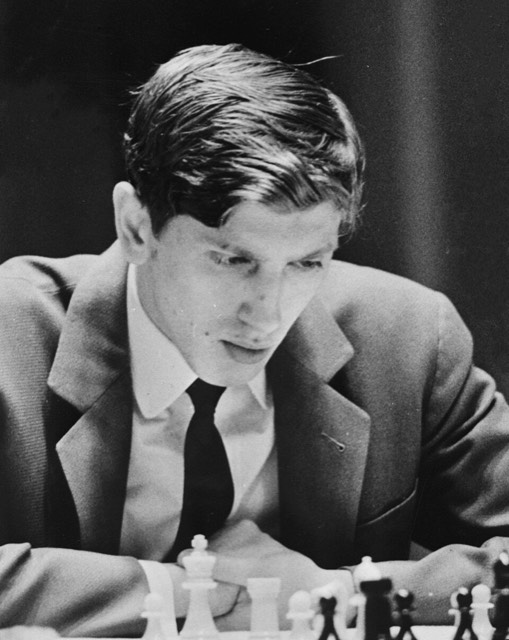
- Born
- March 9, 1943
- Died
- January 17, 2008
- Country
- United States
- World champion
- 1972-1975
- Peak rating
- 2785 (1972)
Fischer was world champion for three years and never defended the title. What his career leaves behind is not a long list of trophies: it is one stretch of 1971-72 so overwhelming that people still analyse it, and two inventions every chess player now uses without thinking about it.
The climb
Robert James Fischer was born in Chicago on 9 March 1943. He became a grandmaster in 1958 at fifteen years, six months and one day, the youngest in history at the time. He won the US Championship eight times, every time by at least a point. In 1963-64 he won it with 11 out of 11, the only perfect score in the event’s history.
Then came the 1971 Candidates cycle, which still has no equivalent. In the quarter-final he beat Mark Taimanov 6-0. In the semi-final, Bent Larsen 6-0. Twelve consecutive wins against two of the world’s best, without conceding a single draw. In the final he eliminated the former champion Tigran Petrosian 6½-2½.
The 1972 match against Boris Spassky in Reykjavik went far beyond chess. This was the Cold War, and an American was about to end twenty-four years of Soviet control of the title. The start was a disaster. In game one Fischer played 29…Bxh2 in a drawn endgame and lost the bishop to 30.g3. In game two he refused to appear over a dispute about the television cameras and forfeited. He was 0-2 down. He won the match 12½-8½.
After that, nothing. In 1975 he demanded a change of format that FIDE partly refused, then stopped replying, and Karpov was declared world champion on 3 April without a game being played. Fischer played no official game between 1972 and 1992. The Spassky rematch, held in Yugoslavia while it was under UN embargo, earned him a US arrest warrant. He never returned to the United States. Iceland granted him citizenship in 2005 and he died there on 17 January 2008.
His style: clarity
The compliment his contemporaries repeated most was not about his attacks. Alexander Kotov spoke of faultless endgame technique. Mikhail Tal, about an entire tournament: “He didn’t leave a single pawn en prise!” Yuri Averbakh noted in the teenager an astonishing composure and precise calculation.
Fischer played fast, very fast, and almost never blundered. His opening preparation ran fifteen or twenty moves deep when his contemporaries stopped at ten. He looked for the move the position demanded, not the move that would inconvenience his opponent. On the eve of the 1972 match, asked about the war of nerves: “I don’t believe in psychology. I believe in good moves.”
His openings
With White, 1.e4, almost always. The phrase attributed to him is three words long: best by test. Against 1…e5 he played the Ruy Lopez, including the Exchange Variation he brought back into fashion in the late 1960s. Against the Sicilian he gave his name to the Fischer-Sozin Attack, with the bishop on c4.
With Black he stayed loyal to the Najdorf variation of the Sicilian Defence, poisoned pawn included, and to the King’s Indian Defence against 1.d4.
He also left two inventions. Fischer random chess, announced in 1996, shuffles the back rank to take the game out of memorisation, and became Chess960. And the increment clock, patented in 1989 and used for the first time in his 1992 match: every time you play a 3+2 blitz game, you are using his patent.
The game of the century
New York, 17 October 1956, the Rosenwald tournament. Fischer is thirteen and has Black against Donald Byrne, an established master. On move seventeen he leaves his queen hanging.
Byrne takes the queen. Fischer wins material back with a run of checks, then conducts a king hunt lasting another twenty-four moves. Mate arrives on move forty-one.
Hans Kmoch named it the game of the century in Chess Review. A telling detail: Fischer left it out of his own book, My 60 Memorable Games, where he did include draws and losses. He judged his games on quality, not fame.
What you can steal from him
A narrow repertoire studied deeply beats a wide one studied superficially. Fischer played 1.e4 nearly always, the Najdorf and the King’s Indian with Black. He knew his positions better than his opponents because he had fewer of them to know.
Work on your endgames. What people praised most in him was his technique. It is also the phase club players neglect most.
Do not leave pawns hanging. Tal’s remark about a whole tournament without a single pawn en prise owes less to genius than to a standard of care, and that one you can hold yourself to tonight.
And the most useful lesson is not technical: he started the match of his life 0-2 down, one of them a forfeit, and won it 12½-8½.
Frequently asked questions
Why did Bobby Fischer lose his title in 1975?
He did not lose it over the board. He demanded a match won by the first player to ten wins, with a clause letting the champion keep the title at 9-9. FIDE accepted the ten-win format but rejected the clause. Fischer stopped replying and Anatoly Karpov was declared world champion by forfeit on 3 April 1975.
What is Fischer random chess?
It is a variant Fischer announced in 1996, now known as Chess960. The back-rank pieces are shuffled randomly across 960 possible starting positions, keeping castling rights and bishops on opposite colours. His goal was to stop games being played from memory in the opening.
What was Bobby Fischer’s rating?
His peak was 2785 on the FIDE list of July 1972. He was 125 points clear of world number two Boris Spassky, a gap never seen since. The record held until Garry Kasparov reached 2800 in January 1990.
What openings did Bobby Fischer play?
With White, 1.e4 almost exclusively, meeting 1…e5 with the Ruy Lopez and the Sicilian with the Fischer-Sozin Attack. With Black, the Najdorf variation of the Sicilian Defence against 1.e4 and the King’s Indian Defence against 1.d4.