
Alexander Alekhine
World champion from 1927 to 1946, the first player to regain the title and a master of combination: Alekhine's career, style and openings.
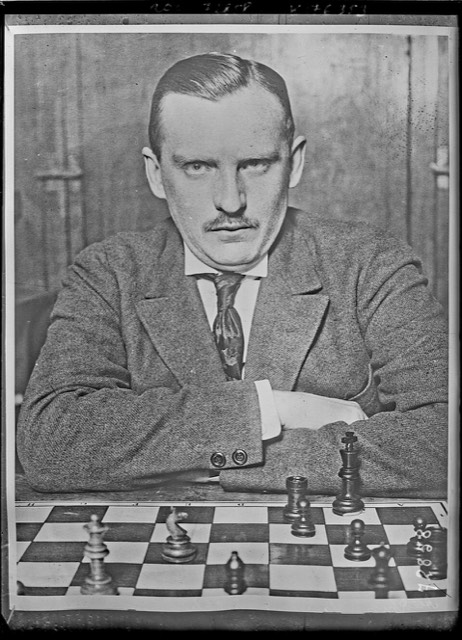
- Born
- October 31, 1892
- Died
- March 24, 1946
- Country
- Russia, then France
- World champion
- 1927-1935, 1937-1946
Rudolf Spielmann found the line that explains Alekhine better than any analysis: I can see the combinations as well as Alekhine, he said, but I cannot get to the same positions. That is the whole thing. His combinations did not fall from the sky, he built the positions in which they became possible.
From Moscow to Buenos Aires
He was born in Moscow on 31 October 1892. He left Soviet Russia in 1921 and became French by decree on 5 November 1927, in the middle of the Buenos Aires match: he gained French nationality a few weeks before becoming world champion.
One thing needs correcting in passing, because it is everywhere: he was called “Dr Alekhine” all his life, but his law doctorate is a myth. He enrolled at the Sorbonne and completed only half the course. The announced thesis was never found. He never denied the title.
In 1927 in Buenos Aires he faced José Raúl Capablanca, unbeaten for three years and overwhelming favourite. The match ran thirty-four games, from 16 September to 29 November, and remained the longest world championship in history until 1984. Alekhine won 18½-15½.
He defended the title twice against Bogoljubov, in 1929 and 1934. Then came the accident: in 1935 Max Euwe beat him 15½-14½ after recovering a three-point deficit. Alekhine took the title back in 1937, decisively, 15½-9½. He was the first player to regain the world title — Botvinnik would do it twice after him.
What he never granted
Capablanca never got his rematch, and the mechanism is worth telling because it is ironic. The London Rules of 1922, drafted by Capablanca himself and signed by every leading master, required the challenger to raise ten thousand dollars. Alekhine simply required Capablanca to satisfy his own rule. He never raised the money. The two never played a match again.
His style: the combination as reward
Kasparov names him as his first influence and describes him as the pioneer of the universal style, in which tactics and strategy are woven together. His combinative vision, he says, rested on sound positional foundations.
That is the point to keep, and it cuts against the image of the inspired genius. Alekhine worked enormously hard. He prepared his openings at a time when that was not yet systematic, and his 1927 victory is as much a win for preparation as for talent. During that match, on a single move of the twenty-eighth game, he thought for an hour and fifty minutes.
His openings
Alekhine’s Defence, 1.e4 Nf6, is pure provocation. The knight offers itself to be chased, inviting White’s pawns to form a broad centre. Not to respect it, but to make it a target and show it is overextended. In an era whose orthodoxy said occupy the centre, that was heresy. He introduced it at the Budapest tournament in 1921.
The rest of his repertoire revolves largely around the Queen’s Gambit Declined, which dominated his 1927 match, and Indian systems. Many variations carry his name across very different openings, from the Budapest Gambit to the Sicilian Defence.
The longest combination of his career
Baden-Baden, 1925, against Richard Réti, the leader of the hypermodern school. Alekhine has Black. On move twenty-six he puts his rook on e3.
What follows runs for fifteen moves and cannot be described: it has to be replayed. Alekhine considered it one of his best games. One point of historical detail is worth flagging: three published versions of this game circulate, differing in the number of repetitions around move twenty. Réti himself, in his notes, places the …h5 push on move twenty-two and states that Alekhine had offered a draw just before.
Three queens
Hastings, 1922. Alekhine needs to win the final round. Against Bogoljubov he pushes a pawn to the enemy second rank and promotes on move thirty-three, just as his queen is captured.
He promotes again on move forty-nine and wins the game. The nickname “game of the three queens” is a journalist’s headline rather than an exact description, but the idea is there.
1940-1946
This has to be covered, and covered without smoothing the edges.
From 18 to 23 March 1941 the Pariser Zeitung, the German daily of occupied Paris, published under his signature a series of six articles titled “Jewish and Aryan chess.” They contrast a so-called Aryan, offensive game with a so-called Semitic conception, defensive and materialistic, and attack by name Emanuel Lasker, Wilhelm Steinitz, Nimzowitsch and Réti. The texts were reprinted in two other German publications. Between 1941 and 1943 Alekhine played some ten tournaments in occupied Europe, organised by the German federation, and gave simultaneous displays in Paris for the German army — which he acknowledged himself in an interview in September 1941.
After the war he claimed to have written nothing of the sort, his purely technical texts having, he said, been rewritten. His explanations varied and contradict each other, and the historian Edward Winter, who examined the file closely, notes that in 1941 Alekhine was on the contrary claiming to have treated chess from a racial standpoint. After his wife’s death in 1956 several witnesses said they had seen the articles in his handwriting among his papers, but their accounts also contradict each other. The researcher Christian Rohrer, who worked on the archives, concludes that whether every word is his matters less than the fact that he bears responsibility for them.
His invitation to the London 1946 tournament was withdrawn and several players refused to face him. Botvinnik challenged him in February 1946; the agreement on the match reached him on 23 March. He died the next day in Estoril, Portugal, the only world champion in history to die holding the title. The inquiries into his wartime conduct were never carried through.
The cause of his death is itself disputed: the autopsy concluded asphyxiation, the heart attack version circulates alongside it, and assassination theories have been advanced. Winter, again, concludes that nobody knows.
What you can steal from him
Go back to Spielmann’s line, because it is the most useful lesson here. You do not learn to see combinations. You learn to build the positions in which they appear.
In practice: play for piece activity and initiative, and the tactics will come. They are the reward for good positional work, not a gift.
Prepare your openings seriously. Alekhine beat the man reputed unbeatable in his era because he arrived better prepared. That is Prologue’s bet too: an opening you understand rather than memorise still leaves you a plan when your opponent leaves theory.
Frequently asked questions
Is Alekhine the only world champion to die holding the title?
Yes. He died on 24 March 1946 in Estoril, Portugal, while still world champion and with a match against Botvinnik just agreed. FIDE had to take control of the title and awarded it through a tournament held in 1948, won by Botvinnik.
Was Alekhine the only player to regain his title?
He was the first, not the only one. He lost the title to Max Euwe in 1935 and took it back in 1937. Botvinnik did it twice after him, against Smyslov in 1958 and against Tal in 1961, before FIDE abolished the automatic rematch.
What is Alekhine’s Defence?
It is the reply 1…Nf6 to 1.e4. The knight deliberately offers itself to be chased by White’s pawns, the idea being to tempt them into a broad centre that then becomes a target. Alekhine introduced it at the Budapest tournament in 1921, against the orthodoxy of the time which held that you should occupy the centre.
What did Alekhine write during the war?
A series of six articles titled “Jewish and Aryan chess” appeared under his signature in the Pariser Zeitung in March 1941, contrasting a so-called Aryan game with a so-called Semitic conception and attacking several Jewish players by name. After the war he claimed his texts had been rewritten, but his explanations varied and historians have never settled the question of their exact authorship.