
Emanuel Lasker
World champion for twenty-seven years, mathematician and friend of Einstein: Emanuel Lasker's career, style and openings.
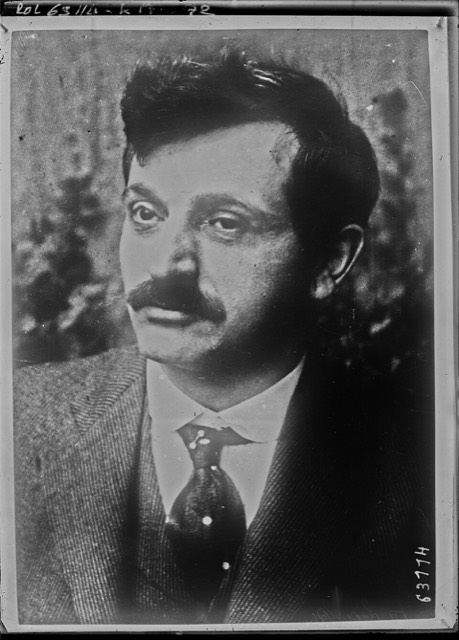
- Born
- December 24, 1868
- Died
- January 11, 1941
- Country
- Germany
- World champion
- 1894-1921
Twenty-seven years as world champion. Nobody has done better and nobody will. Stranger still, Lasker treated chess as one occupation among several: he left a theorem bearing his name in commutative algebra, and Einstein wrote the foreword to his biography.
The longest reign in history
He was born on 24 December 1868 in Berlinchen, Prussia, today Barlinek in Poland. His father was a cantor at the synagogue. His elder brother Berthold, a medical student, taught him chess at around eleven.
In 1894 he took the title from Wilhelm Steinitz by 12 to 7. He was twenty-five, Steinitz fifty-seven. The 1896-97 rematch was a rout: 12½-4½.
He then defended against Marshall in 1907, without conceding a single win, against Tarrasch in 1908, and against Janowski twice. That leaves the Schlechter match of 1910, the most argued-over of them all. After nine games Schlechter led by a point: a draw in the last game would give him the title. He played for the win. He lost. Final score 5-5, and Lasker kept his title. The traditional explanation is that the rules required a two-point margin, but no contemporary document confirms it, and the historian Edward Winter treats the question as open.
The title went in 1921 to José Raúl Capablanca in Havana. Lasker won no games, lost four, and abandoned the match after the fourteenth, citing physical collapse and the Cuban climate. He was fifty-two.
And yet. In 1924 in New York he won the tournament with 16 out of 20, a point and a half ahead of Capablanca, the reigning world champion, and four points ahead of Alexander Alekhine. He was fifty-five and had barely played. In 1935 in Moscow, at sixty-six, he finished third without losing a single game, ahead of Capablanca whom he beat along the way. The Soviet press called it a biological miracle.
The mathematician
His thesis was submitted at Erlangen in 1900, supervised by Max Noether, father of Emmy Noether. The doctorate was awarded in 1902.
In 1905 he published a paper introducing primary ideals and primary decomposition for polynomial rings. Sixteen years later Emmy Noether generalised the result to any commutative Noetherian ring. That is now the Lasker-Noether theorem, a cornerstone of commutative algebra. It was not a collaboration: Lasker proved the theorem, Noether generalised it, and the joint name is recognition granted after the fact.
He was also a philosopher, an author, a bridge player for the German national team, and the inventor of a board game, Lasca, which was sold in boxed sets across Europe and the United States in 1911.
His style: the legend and the reality
For a long time people said Lasker played the man rather than the board, choosing the move that most disturbed his opponent rather than the objectively best one. He supposedly even played weak moves on purpose to muddy the game.
He always denied it, and modern analysis backs him. Andrew Soltis went through his games to dismantle the myth: what looked mysterious to his contemporaries has become standard play. Sacrifices with positional aims, choosing the practical move over the theoretical optimum, counter-attacking before the disadvantage turns critical. His moves looked provocative without being objectively worse — with the difference that they were far more likely to provoke an error opposite. It was not bluffing, it was risk calculation.
The line attributed to him sums up his method better than any analysis:
I do not play with lifeless white and black pieces. I play with human beings, of flesh and blood.
Kramnik notes that he could convert a tactical advantage into a strategic one and back again, which baffled his contemporaries. And tradition credits him with a phrase every player should pin above the board: the hardest game to win is a won game.
His openings
With Black, the Lasker Defence to the Queen’s Gambit Declined carries his name and is still played: after 1.d4 d5 2.c4 e6 3.Nc3 Nf6 4.Bg5 Be7 5.e3 O-O 6.Nf3 h6 7.Bh4, he plays 7…Ne4. The idea is characteristically Laskerian. He does not fear the exchange that doubles his pawns, because the doubling mainly hampers White’s development, and …c5 then frees the position completely. Trade pieces to defuse the opponent’s initiative, even at the cost of a small structural concession.
He also left a defence to the Evans Gambit that practically killed the opening for decades: return the pawn at the right moment and trade queens, which is exactly what the gambit player does not want.
With White he legitimised the Exchange Variation of the Ruy Lopez, 4.Bxc6 dxc6, which everyone judged sterile and drawish.
The double bishop sacrifice
Amsterdam, 1889. Lasker is twenty and faces Johann Bauer. On move fifteen he gives up the first bishop. On move seventeen, the second.
The point is counter-intuitive: the double sacrifice does not deliver mate. It wins the queen: after 18.Qg4+ and 20.Rh3+, she has to interpose on h6, and the fork 22.Qd7 on the two bishops completes the haul. The motif has carried his name ever since, and it has been replayed by Tarrasch against Nimzowitsch as early as 1914, by Miles, and by Judit Polgár against Karpov in 2003.
The masterstroke of 1914
St Petersburg, penultimate round. Lasker has to beat Capablanca to catch him in the standings. He opens with the Exchange Variation of the Ruy Lopez and trades queens on move six.
It looks absurd: the line has a reputation for sterility, and trading queens when you must win looks like surrender. Except that Capablanca was precisely trying to simplify towards a draw. And this variation forces Black to play actively to exploit the bishop pair, failing which White exploits the better pawn structure. Lasker chose the opening that punished his opponent’s exact state of mind.
Capablanca plays too passively and is swept away. The so-called psychological player had not played a bad move: he had chosen the right ground.
The end
In 1933 the Nazis confiscated his property and his house. He was sixty-four and lost everything. He fled to England, then to the USSR, where he renounced German citizenship, took a post at the Moscow Institute of Mathematics and coached the national team. In 1937, at the height of Stalin’s purges, the Laskers used a trip to the United States as an excuse not to return.
He died in New York on 11 January 1941 of a kidney infection, at Mount Sinai Hospital, treated as a charity patient. The man who first imposed high fees to make chess a profession died without a penny.
What you can steal from him
Play the practical move, not the perfect one. You have no engine in your head and neither does your opponent. Set them the most awkward problem you can, given the time they have left.
Complicate early. Lasker counter-attacks before his position goes bad, not after. A disadvantage is treated while it is still small.
Do not give up on a difficult position. That was his signature, and he turned many of them around.
And choose your opening with the opponent in mind, not just the evaluation. St Petersburg 1914 is the textbook case. That is also what Prologue aims to give you: an opening you understand well enough to know when it serves your plan.
Frequently asked questions
How long was Emanuel Lasker world champion?
Twenty-seven years, from 1894 to 1921. It is the longest reign in the history of the world chess championship and will very likely never be matched. He took the title from Wilhelm Steinitz and lost it to José Raúl Capablanca.
Did Lasker really play the man rather than the position?
It is a persistent legend that he always denied, and modern analysis backs him. His moves looked provocative but were not objectively inferior. Among equivalent moves he simply chose the one most likely to provoke an error opposite.
What is the Lasker-Noether theorem?
It is a fundamental result in commutative algebra concerning the primary decomposition of ideals. Lasker proved it in 1905 for polynomial rings and Emmy Noether generalised it in 1921 to any commutative Noetherian ring. Lasker had written his mathematics thesis under Max Noether, Emmy Noether’s father.
What is the Lasker Defence?
It is a defence to the Queen’s Gambit Declined, characterised by 7…Ne4 after 1.d4 d5 2.c4 e6 3.Nc3 Nf6 4.Bg5 Be7 5.e3 O-O 6.Nf3 h6 7.Bh4. It seeks to trade pieces to defuse White’s initiative, accepting doubled pawns in return. It is still played at the highest level.