
Wilhelm Steinitz
First official world champion in 1886 and founder of modern positional chess: Wilhelm Steinitz's career, theory and openings.
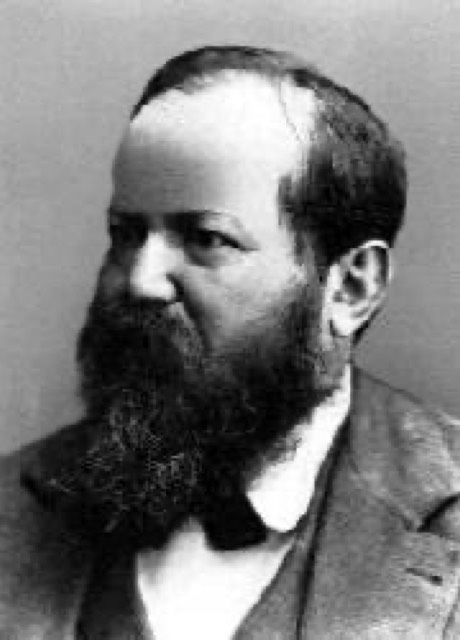
- Born
- May 14, 1836
- Died
- August 12, 1900
- Country
- Austria, then United States
- World champion
- 1886-1894
Steinitz did something almost nobody does: at thirty-seven, at the height of his powers, he abandoned the style that had made his name and invented another one. Kasparov sums it up in a sentence — chess history divides into a period before Steinitz and a period after.
The first world champion
He was born in Prague in May 1836, in the Jewish ghetto, the last of thirteen sons of a poor family. He played in Vienna, moved to London in 1862, then to New York, taking American citizenship in 1888.
In January 1886 he faced Johannes Zukertort in a match whose contract states in writing that it is played for the world championship. That was the first time. The match crossed three cities: New York, St Louis, New Orleans. Zukertort led 4-1 after the first leg, then collapsed. Steinitz won 12½-7½ and became the first official world champion in history.
He defended the title three times: against Mikhail Chigorin in 1889 (10½-6½), against Isidor Gunsberg in 1890-91 (10½-8½), and against Chigorin again in 1892 (12½-10½). Then came Emanuel Lasker. In 1894 Steinitz was fifty-seven and Lasker twenty-five: thirty-two years apart, the widest gap any world championship has seen. Steinitz lost 7-12. It was his first defeat in a serious match since the 1860s. The 1896-97 rematch in Moscow was worse: 4½-12½.
He broke down mentally straight after that match and spent forty days committed to a Moscow sanatorium. He returned to New York penniless. He died on 12 August 1900 at the Wards Island asylum, destitute.
What he changed
In the 1860s they called him the Austrian Morphy. He attacked, sacrificed, played gambits. Around 1873 he changed everything.
His theory comes down to a few ideas, and they are still the basis of the game.
The starting position is balanced. Nobody has an advantage on move one, so nothing justifies attacking. You win only through an opponent’s error, and the work consists of provoking that error, not decreeing an attack.
Lasker put the central principle better than Steinitz himself: the right to attack belongs only to the side with a positional advantage, and it is not merely a right but a duty. Both halves matter. Attacking without an advantage loses. Holding an advantage and temporising dissipates it.
In between, you accumulate small advantages. The combination stops being inspiration and becomes the product of work. And Steinitz distinguishes advantages that last from those that pass: a well-placed knight can be driven off, while an opponent’s backward pawn will still be there in the endgame. Hence his priority on structural weaknesses over passing activity.
One last point, the worst received at the time: defending is legitimate. A level position can repel any assault if defended properly, conceding only under compulsion and as little as possible. In the nineteenth century, accepting a passive position was thought cowardly.
His king, that fighting piece
Steinitz also held that the king is a strong piece, able to look after itself from the middlegame onwards. It is the most contested part of his legacy, and it produced some very strange games.
The Steinitz Gambit, in the Vienna Game, is the demonstration. He introduced it at the Dundee congress in 1867.
Kramnik judges that this theory never joined the classical foundations of the game, and he is right on the substance: modern practice accepts king walks but rejects the generalisation. What remains is the contradiction that defines the man: the founder of positional caution was also the player who took the biggest risks with his king.
His openings
The Steinitz Defence to the Ruy Lopez, 3…d6, sums up his philosophy: solid, slightly passive, conceding space but no structural weakness. He also left his name to a variation of the French Defence.
His distrust of romantic gambits was documented and public. In his Modern Chess Instructor of 1889 he attacked the soundness of the Evans Gambit. Chigorin, the champion of romanticism, took him at his word and challenged him to two games by telegraph, three days per move, with the starting positions imposed. Chigorin won both. The theorist lost the public demonstration, and history would still prove him right on the substance.
Hastings 1895
Steinitz is fifty-nine and has not been world champion for a year. Against Curt von Bardeleben he produces one of the finest games ever played.
From move twenty-two the white rook travels to e7, f7, g7 and h7 giving check, untouchable on every square, while his other pieces sit there hanging.
Von Bardeleben does not resign. He leaves the hall without a word and lets his flag fall. Steinitz then plays out for the audience the mate he had announced, in ten moves.
Look at who produced this: the theorist of positional chess, at fifty-nine. Far from a contradiction, it is his own principle in action. He attacks because he first accumulated the advantage.
What you can steal from him
Do not attack because you feel like attacking. Ask what in the position justifies an attack. If you find nothing, develop, improve your pieces and wait. It is probably the most profitable advice in the whole history of chess for a club player, and it is the exact opposite of instinct.
Defending is not shameful. A level position holds. Concede the minimum, and only when forced.
Aim at weaknesses that last. An opponent’s backward pawn will still be there in twenty moves. Your ideally placed knight will not.
And one last point, which is not technical: he changed style at thirty-seven and became world champion at forty-nine. That is also the idea behind Prologue, which teaches you the intention behind a move rather than the moves that follow: what you understand, you can relearn.
Frequently asked questions
Was Wilhelm Steinitz really the first world champion?
Yes, in the official sense. The 1886 match against Zukertort is the first whose contract explicitly mentions the world championship. Many historians consider, however, that he had in fact been the world’s best player since beating Anderssen in 1866, twenty years earlier.
What is Steinitz’s theory?
It is the foundation of positional chess: the starting position is balanced, you win only through an opponent’s error, you attack only when you already hold an advantage, and in between you accumulate small lasting advantages. He distinguishes permanent weaknesses, such as pawn structure, from temporary advantages such as piece placement.
What is the Steinitz Defence?
It is the reply 3…d6 in the Ruy Lopez, after 1.e4 e5 2.Nf3 Nc6 3.Bb5. It solidly protects the e5 pawn at the cost of a slightly passive position. It illustrates his philosophy well: give up space rather than create a structural weakness.
How did Steinitz lose his title?
He lost it in 1894 to Emanuel Lasker, 7 to 12. Steinitz was fifty-seven and Lasker twenty-five, the widest age gap in world championship history. It was his first defeat in a serious match since the 1860s. He also lost the 1896-97 rematch, 4½ to 12½.