
Paul Morphy
The strongest player in the world of his day, author of the Opera Game and inventor of modern chess: Paul Morphy's career, style and openings.
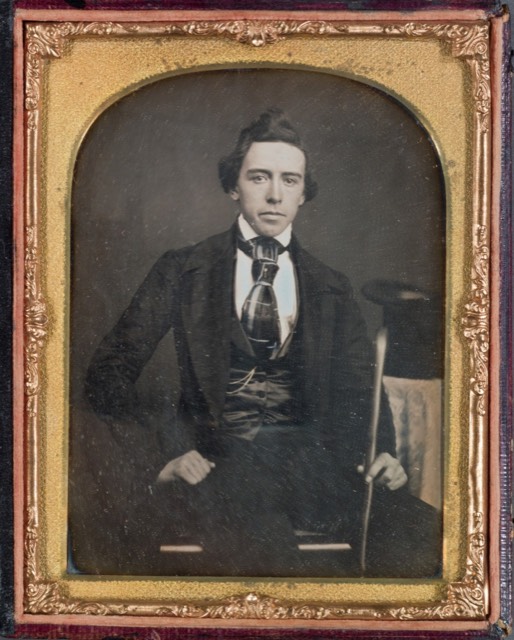
- Born
- June 22, 1837
- Died
- July 10, 1884
- Country
- United States
Morphy played at the highest level for two years, then stopped. He was never world champion, for the simple reason that the title did not exist yet. And still, if you were only going to study one nineteenth-century player, it should be him: his opponents made exactly the mistakes club players make today.
The prodigy from New Orleans
Paul Charles Morphy was born in New Orleans on 22 June 1837, into a Creole family that spoke French at home. His father was a lawyer and later a justice of the Louisiana Supreme Court. Morphy took his own law degree in April 1857, aged nineteen, but never managed to build a practice: prospective clients came to talk about chess, not law.
In the autumn of 1857 he won the First American Chess Congress in New York, beating Louis Paulsen in the final. He then sailed for Europe. His tour comes down to three matches: Löwenthal beaten nine wins to three, Harrwitz beaten five to two before he abandoned the match citing his health, and above all Adolf Anderssen, the strongest player in Europe, beaten seven to two in December 1858. The Anderssen match was played in Morphy’s hotel room because Morphy was ill and being treated with bloodletting.
One name is missing from that list. Howard Staunton, the English authority, never played him. He stalled for three months, then questioned Morphy’s financial guarantees in his own newspaper column. Historians still argue about his real reasons.
Back in the United States in 1859, Morphy announced he would play no further serious match without giving odds of pawn and move: he would take Black, a pawn down. Nobody accepted. He left competitive chess at twenty-two.
The last twenty-five years were bleak. He developed persecution delusions, refused to eat anything not prepared by his mother or sister, and walked the French Quarter talking to himself in French. His family tried to have him committed; he argued his own case so well that the institution refused to admit him. He died of a stroke on 10 July 1884, aged forty-seven. The first official world championship took place two years later, and its final leg was played in New Orleans.
His style: the invention of modern chess
What separated Morphy from his contemporaries was not tactical talent, they all had that. It was that he applied principles systematically where the others applied them by accident.
He develops towards the centre before anything else. He opens lines at the precise moment he has more pieces in play than his opponent. He castles early, while his victims never castle at all. And his sacrifices are not gambles, they are consequences: he sacrifices because he already has the development advantage, not to get one.
Anderssen, after losing, summed up the difference better than any commentator has since: “Morphy wins his games in seventeen moves, and I in seventy.” Kasparov calls him the ancestor of modern chess. Fischer went further in 1964, writing that in a match Morphy would beat anybody alive.
Reuben Fine pushed back on all this: Morphy faced opposition that did not yet know how to defend. His strength is not in question, but the scale of his scores owes a lot to the state of theory in his day.
His openings
In the mid-nineteenth century almost everything started 1.e4 e5, and declining a gambit was close to cowardice. Morphy played the King’s Gambit and the Evans Gambit, both of which open lines immediately, along with the Italian Game and its bishop on c4 aimed at f7.
Late in the European tour, against tougher opposition, he turned to the Ruy Lopez. And here is the detail most people miss: the Morphy Defence to the Ruy Lopez, 3…a6, is named after him and is still the most played variation of one of the most played openings in the world. He is not a historical curiosity.
With Black he also played the Philidor Defence. That is precisely what his opponents use against him in the game below, and he punishes its exact weakness: passivity.
The Opera Game
Autumn 1858, at the Italian Opera in Paris. Morphy is at the opera in the Duke of Brunswick’s box, playing against the Duke and Count Isouard in consultation. The two men argue about their moves out loud during the performance. Morphy is trying to watch the show.
You will often read that The Barber of Seville was on that night. Other sources say Norma. The historian Edward Winter, who examined the question closely, refuses to pick: nobody knows.
Look at the position after move twelve.
This is the single most instructive diagram in chess literature. Castling long tucks the king away and brings the rook to the open file in one move. On the other side, the f8 bishop and h8 rook have never moved.
The most important move of the game happened five moves earlier, though. On move eight Morphy could have taken the b7 pawn with his queen. He plays 8.Nc3 instead. He declines a poisoned pawn: after 8.Qxb7 Qb4+!, the queen trade is forced and the attack fizzles out. Remember that one; it is the most transferable move in the whole game.
The rest is mechanical: an exchange sacrifice to remove the only defender, then a queen sacrifice to deflect the knight.
The queen sacrifice against Paulsen
New York, November 1857, the last game of the American Congress final. Morphy has Black. On move seventeen he gives up his queen with no forced mate at the end of it: he gives it up because the position justifies it.
Every black piece joins the attack and no white piece defends. Emanuel Lasker spotted something else: Morphy missed several faster mates later in the game. Lasker read it as “an indifference to brilliancies once the win is secure.” He was not an aesthete, he was a pragmatist.
What you can steal from him
Develop before you attack. The Duke and the Count never brought out their kingside and lost in seventeen moves. A 1200-rated player loses the same way, for the same reason, every week.
Always ask what an offered pawn will cost you before taking it. That is move 8.Nc3, and it is probably the most profitable lesson in this article.
Only open lines when you are better developed. The corollary matters just as much: when you are the one behind, close the position.
And his games are short. Seventeen moves, twenty-eight moves. You can replay them and understand them completely, which is impossible with a modern sixty-move game. That is Prologue’s logic too: understanding the intention behind a move beats memorising what comes next.
Frequently asked questions
Was Paul Morphy world champion?
No, because the title did not exist in his lifetime. The first official world championship was Steinitz against Zukertort in 1886, two years after Morphy died. He was regarded in his own time as the strongest player in the world, an unofficial status he earned by beating Adolf Anderssen in 1858.
What is Paul Morphy’s most famous game?
The Opera Game, played in Paris in the autumn of 1858 against the Duke of Brunswick and Count Isouard, who consulted on their moves. Morphy won in seventeen moves with an exchange sacrifice followed by a queen sacrifice. It is the most reproduced game in chess history because it teaches development, opening lines and justified sacrifice in a single lesson.
Why did Morphy stop playing chess?
He left competition in 1859, at twenty-two, after announcing he would play no further match without giving odds of pawn and move. Nobody took up the challenge. He played only a handful of odds games afterwards, and his mental health deteriorated over the following years.
What is the Morphy Defence?
It is the move 3…a6 in the Ruy Lopez, after 1.e4 e5 2.Nf3 Nc6 3.Bb5, forcing White’s bishop to make an immediate decision. It carries Morphy’s name and remains the most played variation of the opening at every level today.